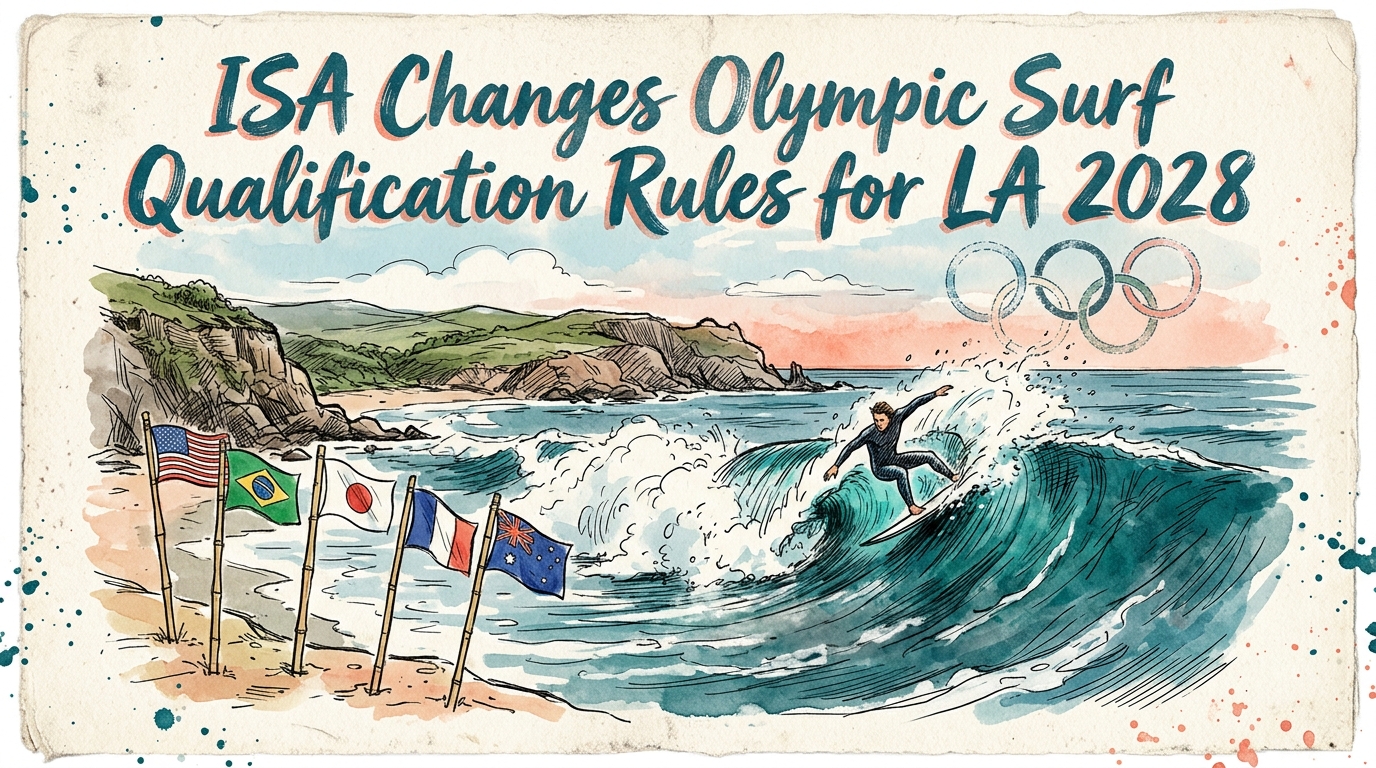

The road to surfing’s third Olympic appearance just took a sharp turn. After months of public criticism from the World Surf League and many of the sport’s biggest names, the International Surfing Association has officially revised the Olympic surf qualification system for the Los Angeles 2028 Games. The updated rules, approved by the International Olympic Committee Executive Board, restore more direct spots to Championship Tour surfers and reshape how nations will fill their rosters.
If you follow competitive surfing, this story matters. It affects who you will see paddling out at Lower Trestles in 2028, how the next two seasons of professional surfing will unfold, and even how emerging surf nations in Africa and Asia can reach the Olympic stage. Here is the full breakdown, explained simply for casual fans and in enough depth for serious followers of the tour.
Why the Olympic Surf Qualification System Just Changed
To understand the update, you need to rewind to early 2026. When the ISA first published its qualification plan for LA 2028, it dropped a bombshell: the number of surfers qualifying directly through the WSL Championship Tour would fall from 10 men and 8 women at Paris 2024 to just 5 per gender.
Instead, the 2028 ISA World Surfing Games would become the centerpiece of qualification, awarding 10 spots per gender. The country quota would rise to three surfers per gender, but with a catch. Both the Championship Tour and the World Surfing Games pathways were capped at one surfer per nation, meaning powerhouse teams could no longer qualify their full squads through the tour alone.
The reaction was immediate and fierce. Reigning world champion Yago Dora called the process disrespectful to the sport. Erin Brooks argued that consistency on the Championship Tour is what defines elite surfing and that the Olympic pathway should reflect it. Leo Fioravanti said the surfers had tried to work with the ISA and were shut out. WSL CEO Ryan Crosby publicly rejected the system, criticizing the lack of consultation behind it.
For a sport that has fought hard for Olympic legitimacy since its debut in Tokyo, the standoff was a genuine crisis. Some observers even speculated about a potential boycott by tour surfers. You can read the original framing of the system on the official ISA qualification page.

What Changed: The New Olympic Surf Qualification Rules Explained
In June 2026, the ISA announced a revised system, approved by the IOC Executive Board. The governing body described it as the result of wide consultation across the surfing community and a balance between rewarding the world’s best surfers and protecting Olympic universality. The full announcement is available in the ISA press release.
Here are the key changes, point by point.
More Championship Tour Spots
The number of direct qualification slots through the WSL Championship Tour increases from 5 to 8 per gender. That is still below the 10 men who qualified through the tour for Paris 2024, but it is a significant win for CT athletes who felt the original plan devalued the world’s premier professional circuit.
A Longer Ranking Window
Under the first proposal, only the 2028 CT rankings as of mid June would count. The revised system extends the window: the top 8 ranked athletes per gender on the Championship Tour between August 15, 2027 and June 15, 2028 will earn their spots. This rewards sustained form across more events rather than a short sprint, though it does create an unusual parallel Olympic ranking that sits apart from the world title race.
A Tighter Country Quota
To balance the extra CT spots, the maximum number of athletes per nation drops from three to two per gender. There is one exception: a nation can earn a third slot through the team qualification places awarded at the 2026 and 2027 ISA World Surfing Games. For dominant surf nations like Brazil, the USA, and Australia, this means brutal internal competition for limited places.
The World Surfing Games Still Matter
The 2028 ISA World Surfing Games remains a major pathway, though its allocation is reduced from 10 spots per gender to 7. Championship Tour surfers chasing qualification through the World Surfing Games will be seeded directly into Round 3, which acknowledges their proven level while keeping the event competitive for national team surfers from around the world.
Old System vs New System: LA 2028 at a Glance
| Element | Original 2026 Proposal | Revised System (Approved) |
| WSL CT spots per gender | 5 | 8 |
| CT ranking window | 2028 season to mid June | Aug 15, 2027 to June 15, 2028 |
| 2028 World Surfing Games spots per gender | 10 | 7 |
| Max athletes per nation per gender | 3 | 2 (third possible via WSG team slots) |
| CT surfers at the WSG | Standard entry | Seeded into Round 3 |
| Total field | 24 men, 24 women | 24 men, 24 women |
The total field size stays the same. What shifted is the weight given to each pathway and how many surfers a single flag can send to Lower Trestles.
Who Wins and Who Loses Under the New Rules
Every qualification system creates winners and losers. Here is how the revision plays out for different groups.
Championship Tour Surfers
The clear winners. Eight direct spots per gender means the tour once again functions as the primary road to the Olympics, and gender equity is now built into the professional pathway. That said, the reduced country quota stings. A surfer ranked fifth in the world could still miss the Games if two compatriots sit above them. If you are new to how the professional circuit works, our overview of the next surf competitions in 2026 is a good place to start following the tour.
National Federations and Rising Talent
Federations outside the traditional powerhouses gain real opportunities. Continental slots remain in place through the 2026 Asian Games, the 2027 Pan American Games, and the 2027 European Surfing Championships. Africa and Oceania each receive one slot per gender through the 2027 World Surfing Games, provided the athlete finishes inside the top 25 overall. A universality place per gender is also reserved for developing surf nations.
This structure keeps the Olympic dream alive for surfers who will never hold a full time CT seat. It reflects the same spirit of inclusion driving movements like adaptive surfing, which continues to push the sport toward broader representation.
African Surfers and the Morocco Connection
For our readers here in Morocco, the Africa slot at the 2027 World Surfing Games is the headline. A Moroccan man and woman could realistically wear the national colors at Lower Trestles, and the country’s competitive infrastructure is growing fast. Events like the WSL Taghazout Pro 2026 and the Morocco Mall Junior Pro in Casablanca are giving local surfers world class competitive reps at home.
If you followed our recap of the WSL Pro at Taghazout Bay, you already know the level of surfing on Moroccan points is rising every season. It is one more reason many observers believe Taghazout is becoming Africa’s surf capital. An Olympic qualification story starting on those right hand points would be a landmark moment for African surfing.

The Venue: Why Lower Trestles Changes Everything
The LA 2028 surfing competition will run at Lower Trestles in San Clemente, California, one of the most consistent high performance waves in the world. Unlike Teahupoo, the heavy Tahitian reef that hosted Paris 2024, Trestles is a rippable cobblestone point that rewards progressive surfing, sharp rail work, and airs.
That choice shapes strategy. Surfers who thrive in punchy, open face conditions will be favored, and national teams will train specifically for that canvas. Team USA is even preparing dedicated wave pool training facilities ahead of the Games. Modern preparation also leans heavily on data, and tools like the AI surf forecasting platforms we reviewed are increasingly part of elite competition planning.

Key Dates on the Road to LA 2028
The qualification race begins almost immediately. Mark these milestones:
- September 2026: Asian Games, awarding one slot per gender to the highest ranked eligible athletes
- November 2026: ISA World Surfing Games in Peru, where the top team per gender earns a national slot
- 2027: Pan American Games, European Surfing Championships, and the 2027 World Surfing Games with continental slots for Africa and Oceania
- August 15, 2027 to June 15, 2028: the Championship Tour ranking window that decides the eight direct qualifiers per gender
- 2028: the World Surfing Games as the final major qualification event before the Olympics
Because the CT and the 2028 World Surfing Games are each capped at one surfer per country, expect top professionals to treat ISA events far more seriously than in past cycles. The era of tour surfers skipping the World Surfing Games is effectively over.
What This Means for the Future of Competitive Surfing
Beyond the immediate qualification math, this episode reveals something bigger about where the sport is heading. Surfing now lives in two worlds at once: the professional tour economy run by the WSL and the Olympic federation structure governed by the ISA and IOC. When those worlds collide, athletes get caught in the middle.
The revised system is a genuine compromise. The ISA protected universality, the principle that surfing’s Olympic presence should develop the sport globally rather than simply showcase its existing elite. The WSL and its athletes recovered meaningful representation for the tour. Neither side got everything it wanted, which is usually the sign of a workable deal.
It is also a reminder of how far the sport has traveled. Surfing spent decades as a counterculture pursuit before becoming an Olympic discipline, a journey we traced in our look at the history of surf culture. Three Games in, the growing pains are real, but so is the opportunity: more funding for national programs, more visibility for emerging surf nations, and more pathways for young surfers everywhere.
For deeper reporting on the negotiation behind the changes, The Inertia published a detailed analysis of the ISA revision worth reading.
Final Thoughts
The updated Olympic surf qualification system for LA 2028 is a course correction born from real conflict. Eight Championship Tour spots per gender, a two surfer national cap, a longer ranking window, and a still meaningful World Surfing Games add up to a fairer, if imperfect, path to Lower Trestles.
For fans, the next two years just became far more interesting. Every CT event from August 2027 onward carries Olympic weight, and every ISA competition from this September matters. Whether you are watching from California, Casablanca, or the cliffs above Anchor Point, the race to LA 2028 is officially on.