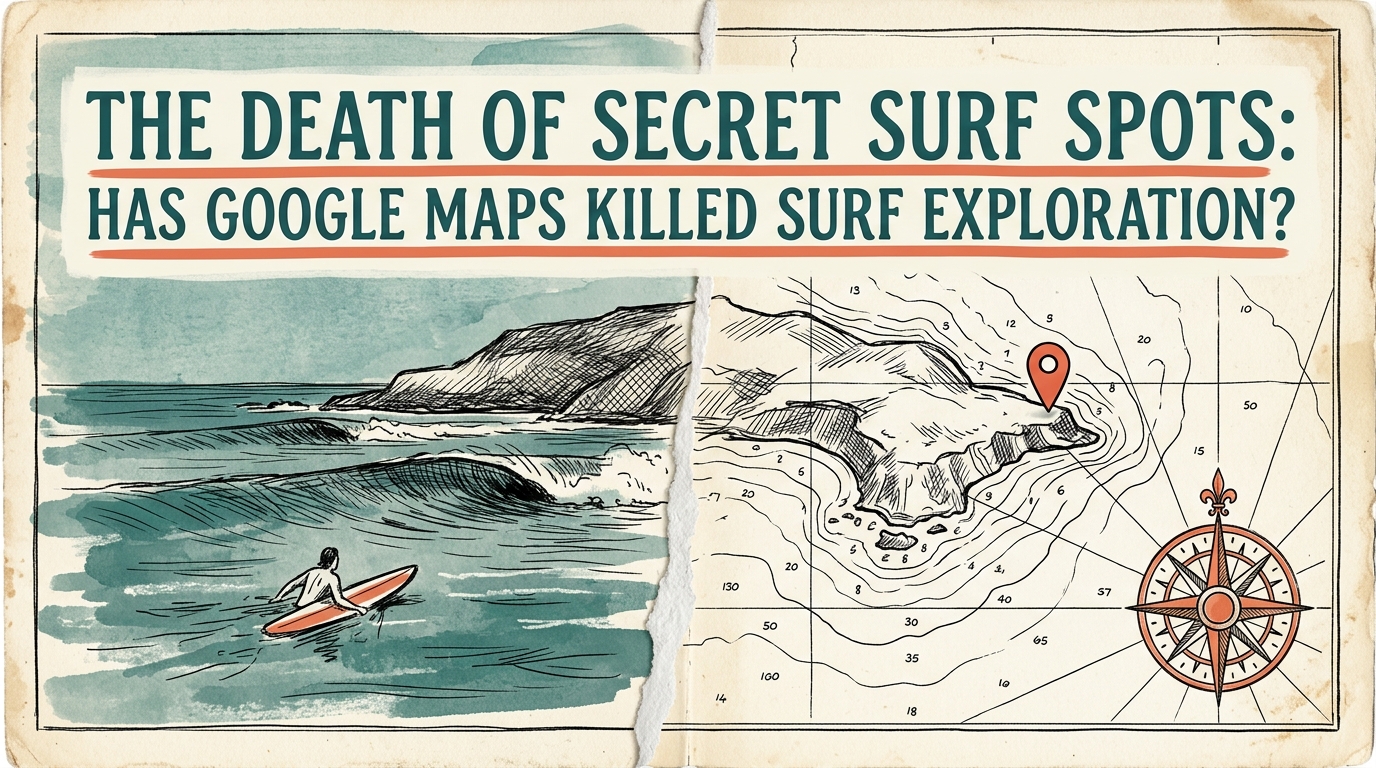

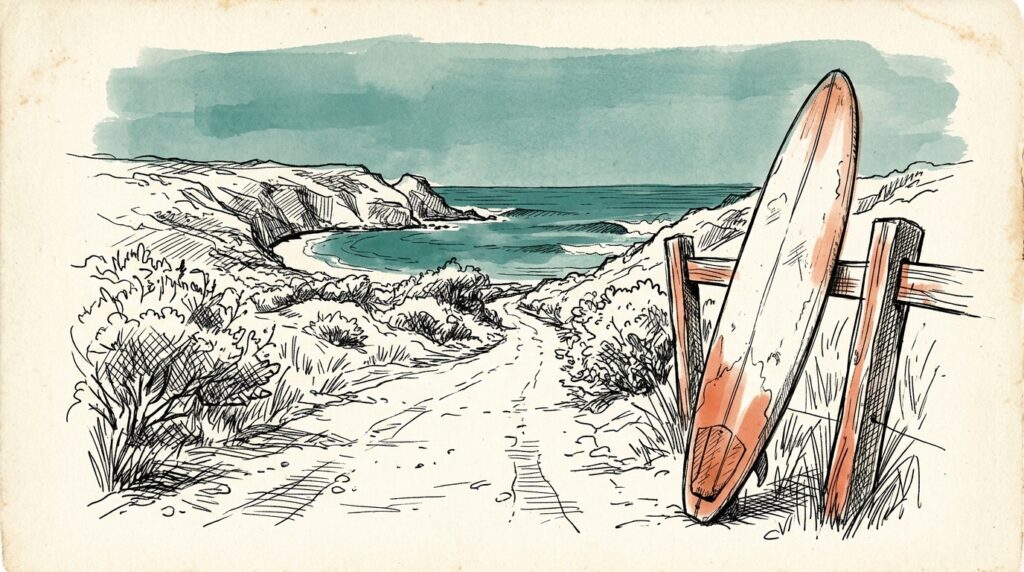
Ask any surfer who started riding before 2010 and they will tell you the same story. There was a break down a dirt road, past a fence, that maybe twelve people knew about. Now there are forty cars in the lot. The death of secret surf spots is one of the most argued-about shifts in modern surf culture, and satellite mapping sits right at the center of it.
This article looks at what actually changed, what did not, and how surfers on both sides of the argument make their case. Whether you are new to the water or you have been guarding a spot for twenty years, the discussion is worth having honestly.
What “Secret Spot” Actually Meant
A secret spot was rarely a wave nobody had ever seen. It was a wave that was hard to reach, hard to read, or hard to time. The barrier was not information alone. It was effort.
Local surfers earned access through years of watching a coastline. They knew which swell direction turned a closeout into a wall, which tide made a reef surfable, and which wind killed it by 9am. That knowledge lived in memory and conversation, not on a screen.
The old system worked because three barriers stacked on top of each other:
- Geographic obscurity. You had to physically find the place.
- Conditional knowledge. You had to know when it worked.
- Social permission. You had to be accepted in the lineup.
Satellite imagery removed the first barrier almost completely. The other two are still standing, which is a detail most of the “Google Maps ruined surfing” arguments skip over.
How Google Maps Changed Surf Exploration
The change happened in stages, and each one mattered more than the last.
Satellite Imagery Made Coastlines Readable
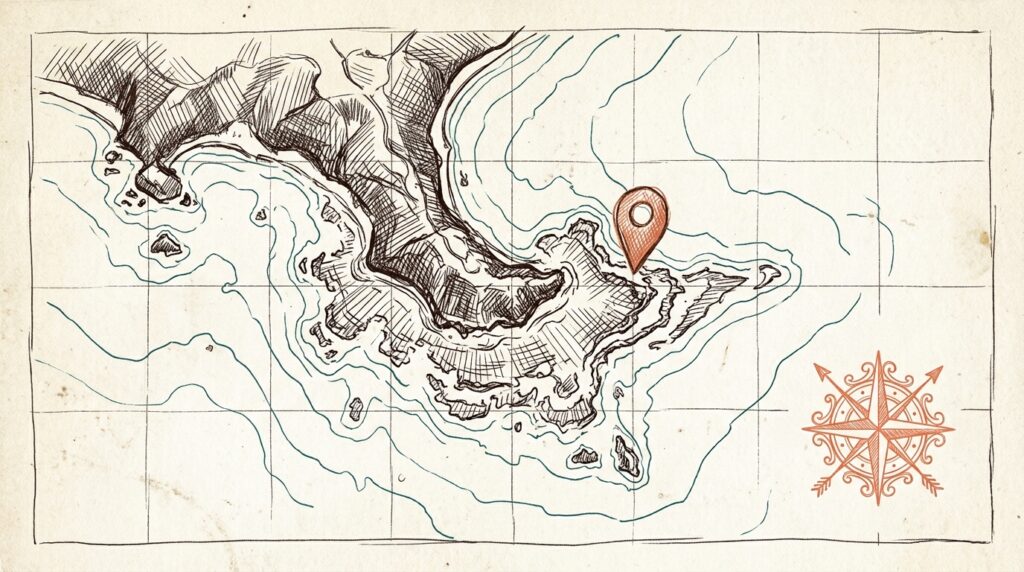
High-resolution satellite views let anyone scan a thousand kilometres of coast from a laptop. Reef shapes, headlands, river mouths, and sandbar patterns are all visible. What used to take a month of driving now takes an afternoon of scrolling.
Experienced surfers learned to read these images the way a shaper reads a blank. A wrapping headland with a sand-bottom point on the lee side is a recognisable signature. Once you know the pattern, you find it everywhere.
Geotagged Photos Closed the Loop
Satellite images show shape. They do not show whether a wave breaks well. Geotagged social media filled that gap by pairing a photo of a perfect A-frame with exact coordinates.
This was the real turning point. A single viral clip can do more damage to a quiet lineup than a decade of satellite imagery. The image proves the wave works, and the tag tells everyone where to park.
Forecasting Tools Removed the Guesswork
Modern forecast models predict swell period, direction, and wind hours ahead with useful accuracy. Free access to buoy data and spectral charts through sources like NOAA’s National Data Buoy Center means the timing knowledge that once took years now takes a tutorial.
If you want to understand how to actually read those numbers, our surf forecasting guide breaks down what each figure means in the water. There is also a growing set of AI-driven forecasting tools doing pattern work that used to be pure local instinct.
The Case That Exploration Is Dead
The pessimistic argument is straightforward and has real evidence behind it.
Crowd density has risen sharply. Surf participation grew significantly after the sport’s Olympic debut, and popular breaks absorbed most of that growth. More surfers on the same finite number of quality waves means fewer waves each.
Discovery has been commodified. Guided “secret spot” tours now sell access to waves that were genuinely obscure a decade ago. The reward for exploration has been converted into a product.
Fragile locations get overwhelmed. Remote breaks often sit next to small communities with limited infrastructure. Sudden visitor spikes create waste, parking, and water pressure that nobody planned for.
Local knowledge lost its currency. When a teenager with a phone can arrive knowing the tide window, the social value of decades of observation drops. That shift has fuelled a measurable rise in lineup friction.
If you surf busy waves regularly, the practical response is not resentment but discipline. Reviewing the unwritten rules of surf etiquette matters more now than it did when lineups held six people.
The Case That Exploration Just Moved
The counterargument is less romantic but harder to dismiss.
Satellite images flatten the ocean into a still picture. They cannot show you a shifting sandbar, a rip that only forms on a spring low, or the three-hour window when a wave stops being a closeout. That knowledge is still earned in the water.
There is also a scale problem people underestimate. Vast stretches of coastline in West Africa, eastern Indonesia, the Philippines, and the Aleutians remain genuinely underexplored, not because they are hidden but because getting there is expensive, uncomfortable, or politically complicated.
Access barriers that mapping cannot solve include:
- Cost. Boat charters and remote flights price out most surfers.
- Risk. Sharks, remoteness, and no medical support deter casual visitors.
- Legality. Private land and protected reserves block entry regardless of coordinates.
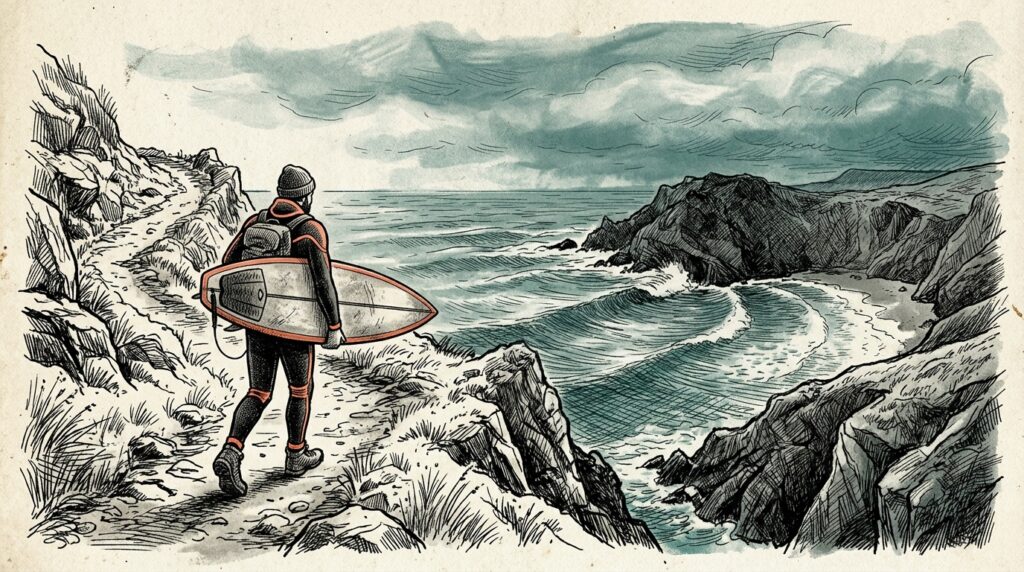
- Physical difficulty. A two-hour hike with a board filters crowds effectively.
Morocco illustrates the point well. Taghazout Bay is thoroughly documented, but there are still quiet waves along that coast, as our guide to Morocco’s lesser-known breaks explores. Documentation and crowding are not the same thing.
The Numbers Behind the Debate
There is one point both sides agree on: crowding is unevenly distributed. A small number of famous breaks absorb a huge share of total surf traffic, while the majority of surfable waves stay relatively quiet.
This matters because it reframes the problem. The issue may not be that information got out. It may be that most surfers choose the wave they have already seen on a screen.
| Factor | Pre-2005 | Today |
| Finding a coastline feature | Weeks of driving | Minutes of satellite scrolling |
| Knowing when it works | Years of observation | Forecast models plus experience |
| Reaching a remote break | Difficult and expensive | Still difficult and expensive |
| Lineup access | Social vetting | Largely open |
| Reward for exploring | High | Lower at accessible spots, unchanged at remote ones |
The row that has not changed is the important one. Physical access remains the real filter, which is why genuinely committed exploration still produces results.
Practical Guidance for Beginners
If you are early in your surfing, the secrecy debate can feel like it excludes you. It does not. Here is how to move through it without causing problems.
Start where you are welcome. Beginner-friendly breaks exist for a reason, and our list of surfing destinations suited to beginners is a better starting point than a wave you found on satellite view.
Match the wave to your ability honestly. A reef break that looks perfect from above is a serious hazard if you cannot handle it. Reading up on safety in challenging ocean conditions is not optional at unfamiliar spots.
Watch before you paddle out. Twenty minutes on the beach tells you about rips, takeoff zones, and who has priority. This is the single most useful habit a new surfer can build.
Do not tag your sessions. If you find something quiet, posting the coordinates is the fastest way to lose it. Nobody in the lineup will thank you.
New surfers often have questions they feel awkward asking in person, which is why we compiled answers to common beginner questions in one place.
Practical Guidance for Experienced Surfers
If you have been surfing long enough to have spots worth protecting, your choices carry more weight than you might think.
Localism and stewardship are different things. Aggression in the water does not protect a wave. It just makes the lineup worse. Quiet, consistent presence does more.
Consider who else uses the spot. In many places, surf tourism supports local families directly. Blanket secrecy can protect a wave while damaging a community that depends on visitors.
Be deliberate about what you publish. Sharing a region is different from sharing a GPS pin. Most experienced surfers have settled on that line, and it holds up well.
Travel with the same standard you expect at home. If you would not want strangers tagging your local, extend that logic abroad. Planning your route thoughtfully, as covered in our surf trip planning guide, makes this easier.
Pros and Cons of Sharing Surf Spots
| Sharing openly | Keeping spots private |
| Pro: Supports local surf economies | Pro: Preserves wave quality and safety |
| Pro: Improves rescue response when locations are known | Pro: Reduces environmental pressure on fragile coasts |
| Pro: Makes surfing more accessible to newcomers | Pro: Maintains the reward for genuine exploration |
| Con: Crowds arrive faster than infrastructure | Con: Can shade into exclusion and gatekeeping |
| Con: Inexperienced surfers may face conditions beyond them | Con: Concentrates knowledge among an established few |
| Con: Fragile sites degrade without management | Con: Withholds economic benefit from local communities |
Neither column is obviously correct. Most surfers end up somewhere in the middle, sharing regions freely and specific breaks rarely.
Where Exploration Goes Next
The frontier has shifted rather than closed. Three areas are still genuinely open.
Conditional discovery. Finding the narrow window when a known wave becomes exceptional is now the highest-value skill in surfing. It cannot be scraped from a satellite image.
Physically demanding access. Hike-in, boat-in, and cold-water breaks continue to filter crowds naturally. Cold water is a particularly effective barrier, which is partly why cold-water destinations stay quiet.
Underdocumented coastlines. Political instability, poor infrastructure, or simple distance keep large stretches of coast off the map in practical terms, even when they are visible from space.
The surfers still finding waves are not the ones with better software. They are the ones willing to be uncomfortable.
Final Thoughts
Google Maps did not kill surf exploration. It killed one specific type of exploration, the kind based purely on knowing where something is. What replaced it demands more: better forecasting literacy, higher fitness, more travel commitment, and a genuine relationship with a coastline.
The romantic version of secret spots was always partly myth. What was real was the effort behind it, and effort is still the thing that separates surfers who find waves from surfers who follow pins.
Over to you: should surfers keep new breaks secret, or is sharing them good for everyone? Drop your take in the comments.