
Few thoughts can hijack a surf session like the flicker of a dark shape moving under your board. Learning how to survive a shark attack — and, more importantly, how to avoid one entirely — turns that primal jolt of fear into something you can actually manage. Sharks share every lineup we love, but the real statistical risk to surfers is much smaller than headlines suggest. This guide brings together fresh 2025 attack data, the science behind why sharks bite, the myths worth retiring, and the practical safety tips experienced surfers rely on when the ocean gets unpredictable.
The Real Numbers: Shark Attack Statistics Every Surfer Should Know
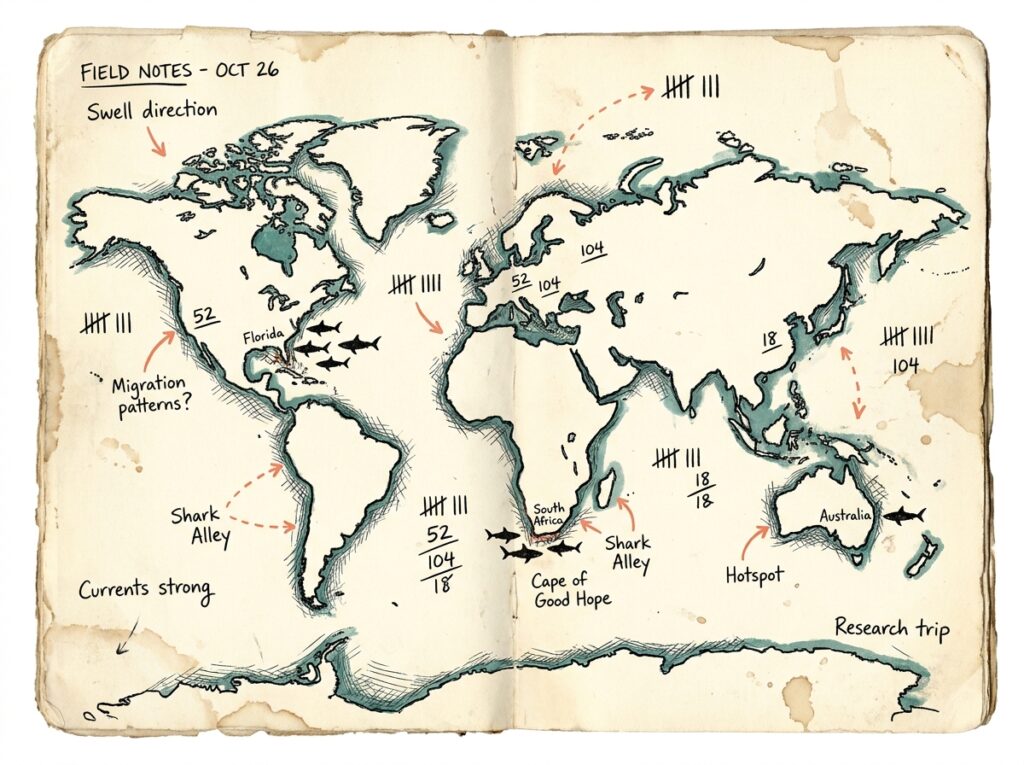
The Florida Museum of Natural History’s International Shark Attack File (ISAF) is the most reliable global database tracking shark-human encounters. In 2025, ISAF confirmed 65 unprovoked shark bites worldwide, very close to the recent five-year average of 61 incidents. Twelve of those bites were fatal — double the decade average of six.
The United States led with 25 unprovoked bites (Florida alone accounted for 11, or 44% of the U.S. total), followed by Australia with 21 confirmed cases and an unusually high 5 fatalities — every Australian fatality involved a white shark. Most incidents happen in temperate or tropical hotspots where surfers and sharks share the same productive coastal waters.
Context matters far more than raw numbers. A 2015 Stanford study estimated the odds of a fatal shark encounter at roughly 1 in 4.3 million per beach visit. By comparison, drowning claims over 4,000 American lives every year according to the U.S. Centers for Disease Control and Prevention. You are statistically more likely to be killed by a falling coconut or a lightning strike than by a shark.
That said, surfers are not average ocean users. Boardriders log far more hours in the surf zone than swimmers or divers, which is why surfing tops the cumulative activity count over the past 50 years with roughly 1,289 recorded attacks. The risk is real — just not the apocalyptic risk Hollywood has been selling us since 1975.
Why Sharks Bite Surfers: Mistaken Identity or Curiosity?
Understanding what drives a shark to bite matters because it shapes the right response. Two main scientific theories dominate the conversation, and both have credible evidence behind them.
The Mistaken Identity Theory
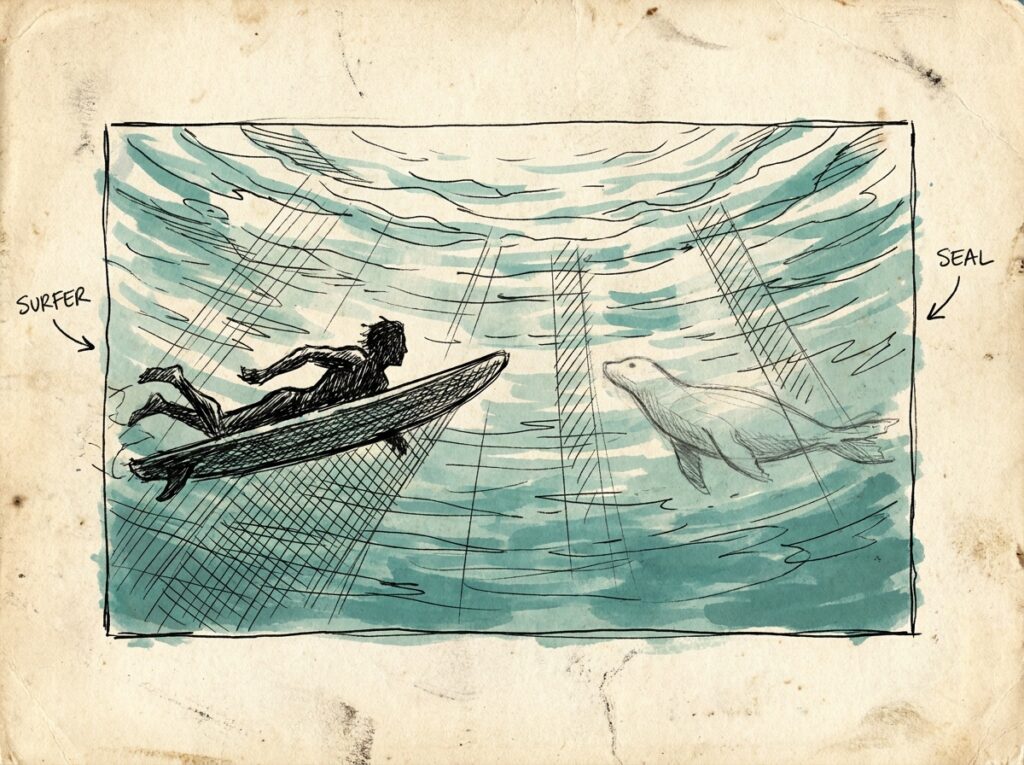
First proposed by researcher H. David Baldridge in 1974, this idea holds that sharks bite surfers because they confuse a paddling boardrider with a seal or sea turtle. A 2021 Macquarie University study used underwater footage shot from a great white’s-eye view to confirm that pinniped silhouettes and surfer silhouettes look strikingly similar from below.
Wetsuits, the prone paddling posture, and dangling limbs all reinforce that visual ambiguity. This is why exploratory bites are most common in species like great whites, which evolved to ambush fast-moving marine mammals from underneath.
The Natural Exploration Counter-Theory
Some scientists, including Dr. Erich Ritter, push back on the mistaken-identity model. Over 76% of shark-surfer incidents produce only superficial or moderate injuries — nowhere near the catastrophic damage sharks inflict on actual seals. Because sharks lack hands, they use their mouths as sensory tools. Many bites may simply be a shark investigating an unfamiliar object.
Either way, the takeaway is the same: surfers are almost never the intended meal. Most encounters end with the shark moving on once it realizes the human isn’t food.
Seven Shark Attack Myths Worth Retiring
Bad information feeds panic, and panic kills good decision-making in the water. Here are seven persistent myths the data simply doesn’t support, drawn from the Georgia Aquarium’s shark research summaries and peer-reviewed studies.
- Myth 1: Sharks hunt humans for food. Of more than 500 species, only the great white, tiger, and bull have double-digit fatal attack totals — and humans aren’t preferred prey for any of them.
- Myth 2: A single drop of blood draws sharks from miles away. Their olfactory system is excellent but not magical. That claim is folklore.
- Myth 3: All sharks are dangerous. Of the 360-plus known species, the overwhelming majority are completely harmless to humans.
- Myth 4: A shark must keep swimming or it will drown. Only ram-ventilating species like great whites need constant motion; nurse and zebra sharks rest on the seafloor and pump water through their gills.
- Myth 5: One bite triggers a frenzy. Most incidents involve a single exploratory bite, after which the shark swims away.
- Myth 6: Shallow water is safer. Bull sharks thrive in murky shallows, estuaries, and even freshwater rivers.
- Myth 7: Sharks are mindless killers. Sharks have large brains, complex social behaviors, and curiosity — closer to dogs than to monsters.
Pop culture is largely responsible for the lingering hysteria. Films from the classic Jaws-era surf cinema cemented an image of sharks as remorseless killing machines, but modern shark biology paints a much more nuanced picture.
Safety First: How to Reduce Your Risk Before Paddling Out
The single best way to win the encounter is to never have one in the first place. Shark safety starts on the sand, not in the lineup. The following habits cut your risk dramatically without forcing you off the water.
Choose When and Where You Surf
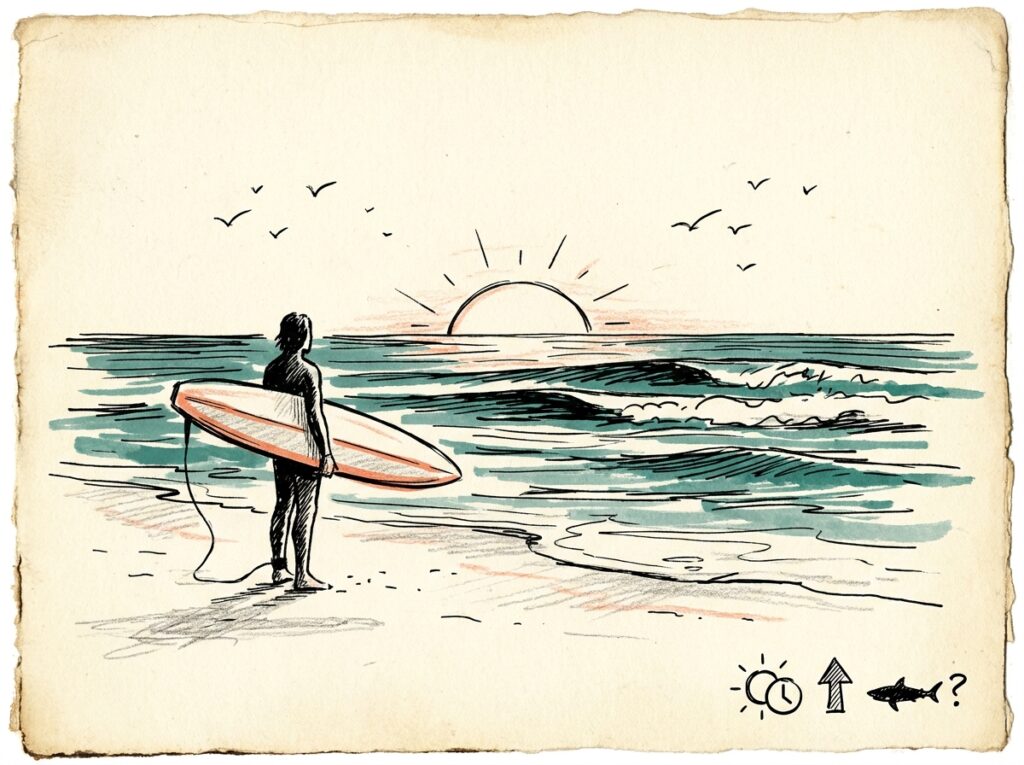
Sharks are crepuscular — most active at dawn and dusk, when low light favors their hunting style. Skip the first and last hour of daylight in known shark zones. Avoid river mouths, harbor inlets, and obvious seal colonies; bull sharks in particular patrol estuaries year-round.
Stay out of murky or post-storm water for at least 24 hours after heavy rain stirs up baitfish. Reading conditions properly is part of every responsible session — checking a reliable wave and weather forecast before paddling out gives you a clearer picture of marine activity, not just swell. If you’re still scouting where to surf safely as a beginner, choose destinations that prioritize protected, well-patrolled lineups.
Watch What You Wear
High-contrast colors and shiny jewelry mimic the flash of fish scales, which can trigger curiosity in species like bull sharks operating in low-visibility water. Solid, muted-tone wetsuits reduce that signal. Skip metallic watches, anklets, and bright orange — anecdotally, great whites bite orange more often than other colors.
If you’re rethinking your kit, our guide to what to wear surfing in different conditions covers neoprene basics, and our walkthrough on choosing a wetsuit that fits properly explains why a snug, low-contrast suit is also the smart shark-safety call.
Stay Aware of Your Surroundings
Diving seabirds, jumping baitfish, or unusual dolphin behavior all signal that something is feeding nearby. Bait balls — tight clusters of small fish bunched against predators — are major red flags. Paddle in if you spot one.
Surfing in a group is also a small but real deterrent; sharks favor isolated targets. Don’t paddle out alone if you can avoid it, especially in unfamiliar water or at remote breaks.
If You See a Shark: Step-by-Step Tactics
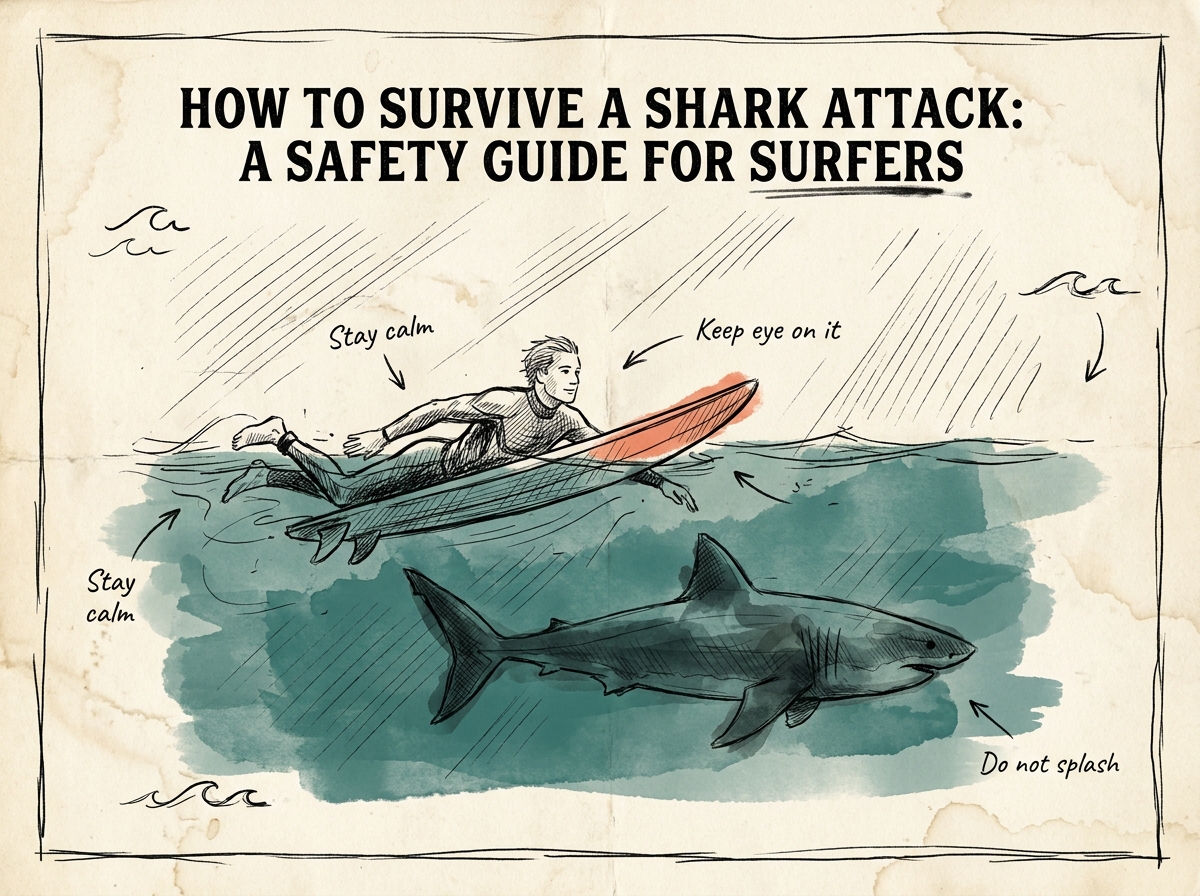
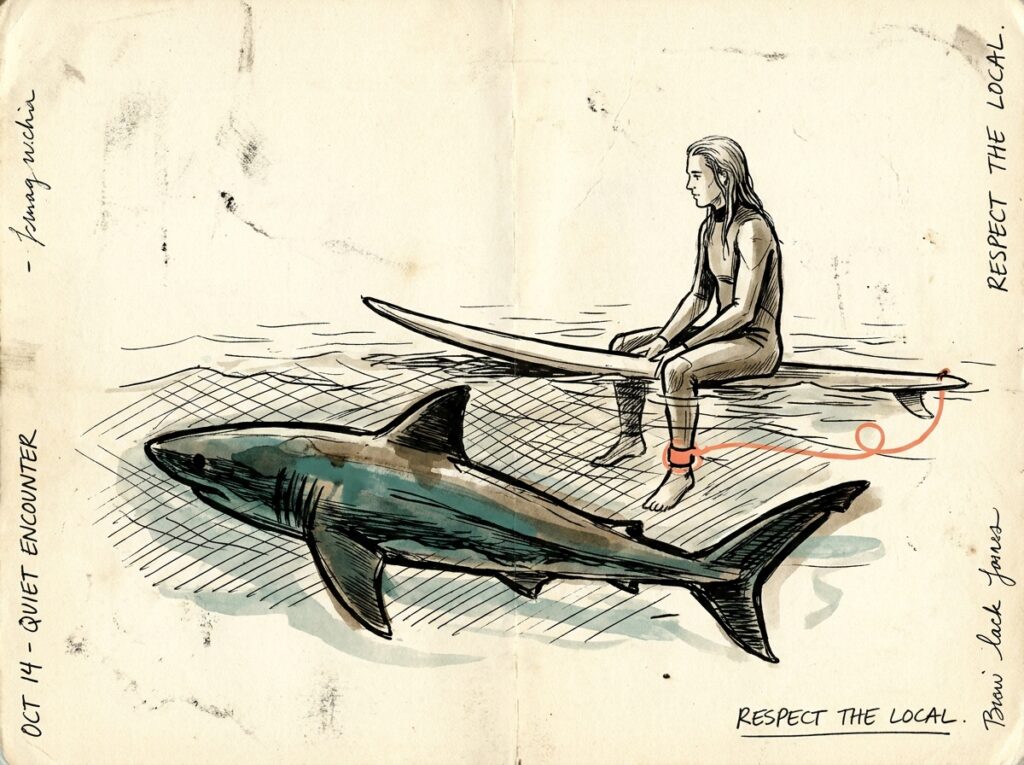
Spotting a fin in the lineup doesn’t automatically mean you’re about to be attacked. Sharks are inquisitive; most cruising sharks investigate, then leave. Shark-attack survivor Paul de Gelder, who lost a hand and a leg to a bull shark, told CBS News in 2025 that staying calm is the single most important thing a person can do in that moment.
- Stay calm. Panic and erratic splashing mimic injured prey and escalate the situation.
- Make eye contact. Sharks prefer ambush; staring them down often makes them break off.
- Sit up on your board to look bigger and less prey-shaped from below.
- Keep your board between you and the shark — it doubles as a shield.
- Move toward shore or a boat in slow, deliberate strokes. No frantic paddling.
- If you’re in a group, regroup tightly and exit together.
Managing fear in that moment takes more than knowledge — it takes a calm nervous system trained by experience. Regular surfing actually strengthens that response, which is part of why surfing’s documented mental health benefits include improved stress regulation and emotional resilience.
How to Survive a Shark Attack If You Are Bitten
Once contact has been made, your response in the first few seconds matters most. ISAF reports that the survival rate for shark bites exceeds 80%, and aggressive resistance directly improves that outcome. Sharks abandon prey that fights back hard.
Fight Back: Target the Sensitive Spots
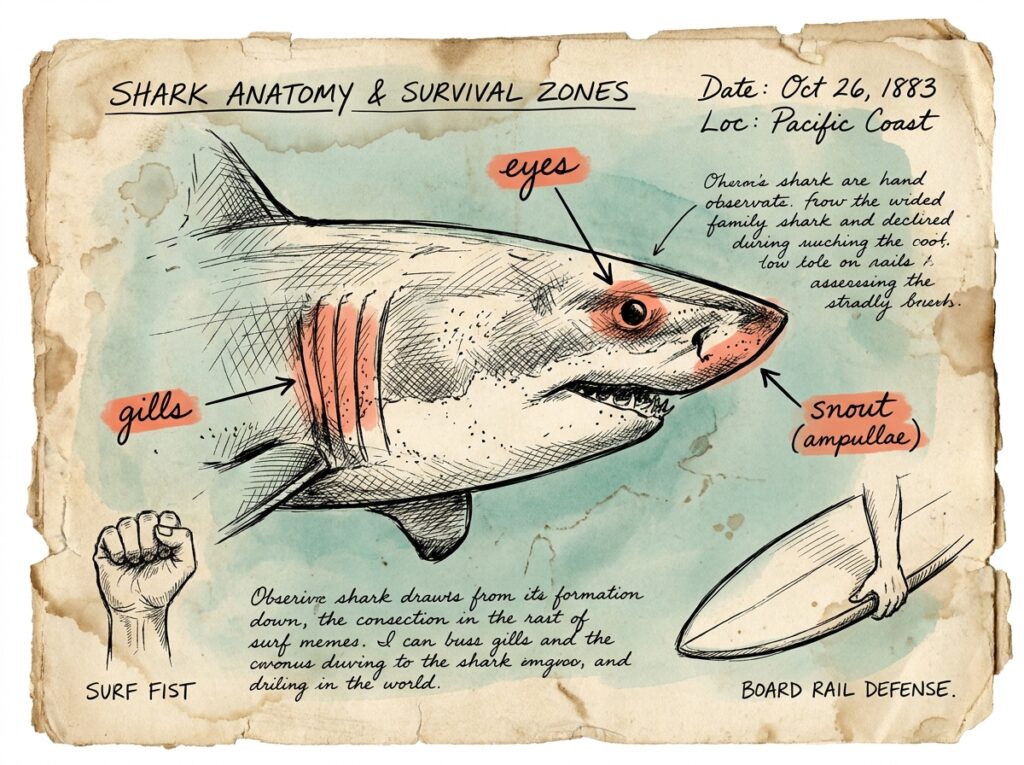
A shark’s most vulnerable areas are its eyes, gills, and snout. Driving force into any of these areas often makes the animal release and retreat. Underwater, a push generates more usable force than a punch, because water resists the punch’s arc.
- Aim for the eyes first — the most sensitive structure on a shark.
- Hit the gills hard if eyes aren’t reachable. They are densely innervated and easily damaged.
- The snout (around the ampullae of Lorenzini) is supersensitive to electrical input — strikes there overload the shark’s senses.
- Use any object: your board, a fin, even a balled fist or elbow.
- Do not play dead. Sharks aren’t bears.
- If a limb is in the shark’s jaws, focus every ounce of force on eyes and gills.
This is where conditioning helps. A baseline of paddle strength, core stability, and breath control gives you the physical capacity to fight back when adrenaline arrives. A dedicated surfing fitness routine pays off in moments like these even more than it pays off in the lineup.
After the Bite: First Aid and Medical Response
Once you’re free, get to shore quickly but steadily; thrashing draws more attention. Major blood loss is the leading cause of death in shark attacks, not the bite itself. Use your leash, a rash vest, or any cloth to apply firm direct pressure or an improvised tourniquet above the wound on a limb.
Call emergency services immediately — even minor bites can introduce serious infections from marine bacteria like Vibrio. Keep the victim warm, still, and reassured while waiting for paramedics. A small first-aid kit in your beach bag — gauze, gloves, an emergency tourniquet — has saved lives more than once.
The Bigger Picture: Coexisting With Sharks
Global shark populations have crashed roughly 71% since 1970, largely from overfishing and finning. Sharks are ecosystem engineers; removing them collapses fish stocks and degrades reef health. The lineup belongs as much to them as it does to us — and that perspective is genuinely useful when you’re weighing risk.
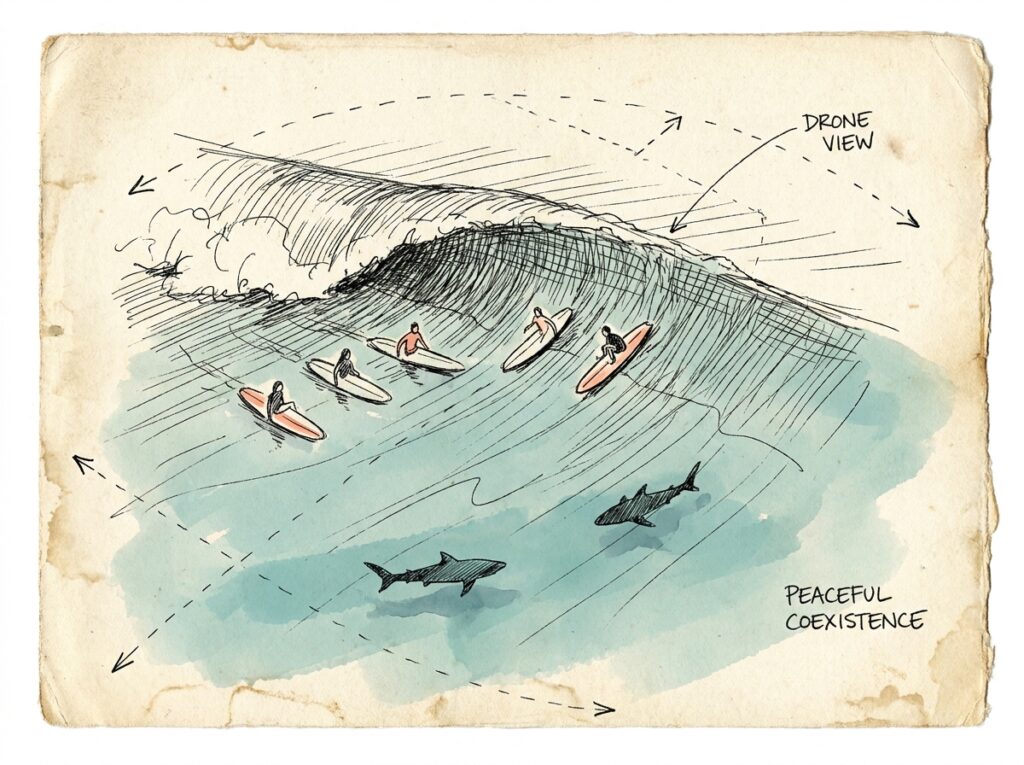
Drone footage now shows surfers and sharks coexisting peacefully every single day, on every continent with a coastline. Centuries of surf culture and history, from West Africa to Hawaii, are also centuries of shared water with apex predators. The fear is mostly inherited, not earned.
For newer surfers, this is worth internalizing early. Time in the water builds judgment, and judgment is what keeps you safe. Our overview of how long it actually takes to learn to surf gives realistic expectations — and a longer relationship with the ocean almost always means a calmer, smarter one.
Final Word: Awareness Beats Fear Every Time
Knowing how to survive a shark attack starts long before you spot a fin. Awareness, calm decision-making, the right timing, and basic respect for the environment do most of the heavy lifting. The statistics are firmly on your side; preparation tilts them further still. Paddle out informed, paddle in humble, and treat every shark you ever see as a privileged sighting of an animal far older than our sport. That mindset — more than any single tactic — is the real safety guide.