
Agadir sits on Morocco’s sun-soaked Atlantic coast and has quietly become one of the most exciting surf destinations on Earth. The best surf spots in Agadir stretch from the city’s calm beach right up the coast through Tamraght and Taghazout, offering waves for everyone — from first-timers to seasoned pros chasing point-break perfection.
This 2026 guide breaks down every spot worth knowing, who it suits, when it fires, and the conditions to look for. You’ll find soft sandy beach breaks for learners, mellow points for improving surfers, and world-class right-handers that have drawn pros to Morocco for over fifty years. Best of all, you can surf comfortably in a 3/2 wetsuit nearly year-round.
Why Agadir Is a World-Class Surf Destination
Agadir is the gateway to Morocco’s “Surf Coast” — a roughly 30-kilometre stretch between Anza in the south and Cap Ghir in the north. The Atlantic generates consistent groundswells from the northwest, and the headlands along this coastline bend them into long peeling waves.
Compared with European spots like Cornwall or the Basque Country, Agadir produces surfable waves every single month of the year, thanks to a wide swell window and water that rarely drops below 16°C. Add winter sunshine, vibrant Berber culture, and unbeatable value, and you have a destination that’s hard to top.
If you’re brand new and want to see how Morocco stacks up against other learner-friendly coastlines, our roundup of top surfing destinations for beginners is a good place to start before booking.
Best Beginner Surf Spots in Agadir
These spots feature sandy bottoms, gentle waves, and surf schools on the beach. They’re forgiving places to learn the basics — paddling, popping up, and riding the whitewater toward green walls.
1. Agadir Beach (Plage d’Agadir)
The city’s main bay stretches for 6.5 kilometres of clean sand and is the most accessible spot if you’re staying in Agadir itself. Waves are typically small to chest-high, soft, and easy to catch, especially on an incoming tide.
It’s perfect for absolute beginners taking their first lesson. Several local schools operate directly on the beach with rentals and certified instructors. If you’ve ever wondered how long it takes to actually learn to surf, this is the place to find out.
2. Tamraght Beach & Crocos (Crocodile Beach)
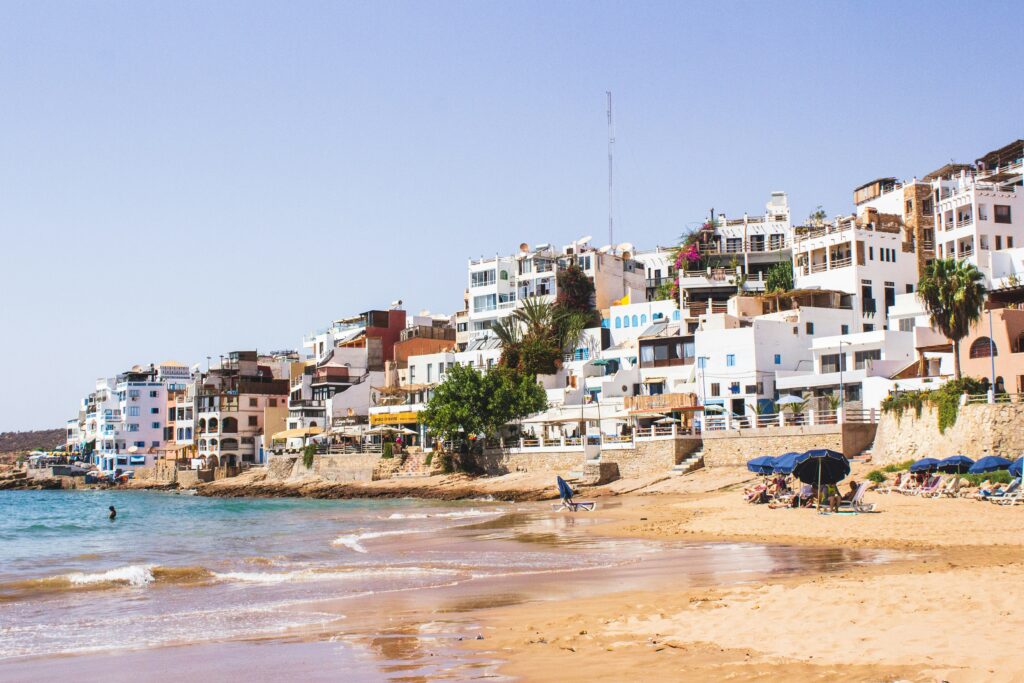
A 20-minute drive north of Agadir, Tamraght’s main beach (also known as Crocos) is a long, sandy beach break with multiple peaks. The waves are mellow, the sandbanks shift just enough to keep things interesting, and the line-up rarely feels intimidating.
It’s a favourite training ground for surf schools and a great place to graduate from whitewater to your first green waves. A foam board with plenty of volume makes this spot incredibly fun — our guide to the best soft tops for beginners covers what to look for.
3. Banana Beach (Aourir)
Just north of Tamraght, Banana Beach is named after the banana fields that line the river valley behind it. The beach break here is widely considered one of the most reliable beginner spots in the entire Taghazout Bay area.
On small swells it offers soft, rolling waves with sandy peaks. When the swell jumps overhead, the adjacent point fires for more experienced riders. There’s parking on the cliff above, a few small cafés, and a relaxed vibe perfect for a full-day session.
4. Panoramas (Taghazout)
Tucked just south of Taghazout village, Panoramas is a wide, sandy beach break that almost every surf school in the region uses for first lessons. It’s clean, easy to read, and works on most tide stages, though mid-to-high tide is best.
When the swell is small, the inside reforms make for endless pop-up practice. When it’s bigger and offshore, Panoramas can transform into a world-class wall — but it’s rare to see it firing while beginners are in the water.
5. Hash Point
Hash Point breaks right inside Taghazout village, directly below the rooftop cafés. It’s a wedgy right-hander that peels just below the roof terraces of the village’s surf camps — soft, mellow, and convenient enough to walk to with your board under one arm.
This is also where many surfers transition from soft tops to hard boards. If you’re sizing up your first proper shortboard, our breakdown of how to choose the right surfboard size is worth a read first.
Best Intermediate Surf Spots in Agadir
Intermediate surfers get the most variety out of the region. These spots demand a confident pop-up, basic wave-reading skills, and the ability to paddle yourself out and read the line-up.
1. Devil’s Rock (Tamraght)
Devil’s Rock is one of the most consistent breaks in Taghazout Bay. It’s a beach break with rights and lefts wedging off a large rock at one end, and it produces rideable waves through nearly every tide. According to Surfline, Devil’s Rock can be fun for more advanced surfers too, thanks to its consistency and ability to work through all tides.
Intermediate surfers will love practicing cutbacks and top turns on its punchy faces. Surf schools cluster here, so expect company, but the wave handles crowds well thanks to multiple peaks.
2. Banana Point
Just up the coast from Banana Beach, the right-hand point break is a mellow, long ride best suited to intermediate surfers and longboarders. It works best on a small-to-medium northwest swell at low or rising tide.
Banana Point is one of the most photogenic waves in the region — long walls, palm trees, and a cliff for spectators. If you’re riding a log, you’ll have the time of your life here. We’ve covered the best longboards for cruisey waves elsewhere on the site.
3. La Source
La Source sits 100 metres north of Anchor Point and breaks over a mix of sand and reef. The “A-frame” peak offers both a left and a right, with the right being the more common pick. Local surf media has reported the wave is good enough that Kelly Slater paid it a visit during his time in Taghazout.
It’s named for the freshwater spring that bubbles out of the rocks at low tide. Mid tide with a NW swell and east offshore winds is when it sings — fast, rippable, and rewarding for intermediate to advanced riders.
4. Imsouane — The Bay
About 75 minutes north of Agadir, Imsouane is home to one of Africa’s longest waves. The Bay is a right-hand point that, on a clean groundswell, can peel for 600 to 700 metres — a dream for longboarders and intermediates chasing endless rides.
Note that Imsouane went through controversial demolitions in early 2024, but the wave itself is unchanged. Local surf coaches have confirmed Imsouane was not completely destroyed — surf shops, restaurants, hotels and the magic of the wave are all still there, with the village actively rebuilding.
Best Advanced Surf Spots in Agadir
These are the spots that put Morocco on the world map. Reef and rock-bottom point breaks, fast walls, and the occasional barrel — reserved for surfers who know what they’re doing.
1. Anchor Point (Taghazout)
Anchor Point is Morocco’s most famous wave. Surfline describes it as Morocco’s most legendary wave — a long right point running along a rock shelf with hollow sections and plenty of room for high-performance surfing. On a big northwest swell, the wave can connect for over a kilometre.
Take-off happens right off the rocky headland, leading to a workable wall that gets hollow on the inside. It’s busy, competitive, and one of the most rewarding rides on Earth when you score it. Best on NW swells of 4–8 feet with east offshore winds, December to February.
2. Killer Point
Named after the killer whales once spotted offshore, Killer Point is a powerful right-hander 20 minutes’ paddle from the rocky headland. The wave is long, workable, and offers occasional barrels — a true high-performance setup.
It’s open to bigger swells than Anchor and tends to be less crowded thanks to the long paddle. The reef floor is shallow with rocks and urchins, and the wave is recommended for intermediate to advanced surfers comfortable with long workable walls. Booties aren’t a bad idea.
3. Boilers (Cap Ghir)
Named after a rusting ship’s boiler washed up on the rocks, Boilers is one of the most consistent advanced waves in Taghazout Bay. It’s a powerful right-hander that barrels frequently due to the offshore wind wrapping around the Cap Ghir lighthouse, breaking over very shallow reef with sea urchins and sharp rocks to navigate.
Reserved strictly for experienced surfers — the rocky entry and exit can be brutal. Best at low tide, though it works on all tides when the swell is solid. If you’re chasing waves like this, read up on essential safety tips for challenging ocean conditions first.
4. Mysteries
Mysteries sits between Anchor Point and La Source and shows two very different faces. On big NW swells it fires like a whirlpool at the take-off, with water sucking off a mixed reef-sand bottom — one of the most technical take-offs in the area.
When it’s working at size, it’s experts only. When it’s smaller, upper-intermediate surfers can have a great session learning to read shifty point-break peaks.
5. Spiders
Spiders is a hollow reef break just south of Devil’s Rock that only really comes to life from November to March. The wave is fast, tubular, and can sometimes connect all the way down to Banana Point.
The reef is shallow, the take-off is critical, and the crowd is generally local. It’s a high-reward spot for advanced surfers — but a place to watch from the cliff before paddling out.
When to Surf Agadir: Seasonal Breakdown
The Agadir coastline works year-round, but each season has its character. Matching your trip to your level matters more than any other planning decision.
- Winter (November–February): Prime time. Big NW swells light up every point break; Anchor, Killer, and Boilers fire. Water sits around 16–18°C.
- Spring (March–May): Mellower, cleaner conditions. Great for intermediates progressing on Devil’s Rock, Banana Point, and La Source.
- Summer (June–September): Smaller waves, ideal for beginners learning at Agadir Beach, Crocos, and Panoramas. Warmer water (around 20°C).
- Autumn (October–November): A sweet spot — early winter swells start arriving but crowds remain thin.
Cross-reference daily forecasts before deciding where to paddle out. Our surf forecast and wave reading guide covers what to look for; for real-time conditions, Surfline and Windguru remain the industry standards.
What to Pack for an Agadir Surf Trip
Morocco rewards travellers who pack smart. Here’s what locals recommend:
- Wetsuit: A 3/2 mm full suit covers you almost year-round; a 4/3 adds comfort on peak winter mornings. Our wetsuit buyer’s guide walks through sizing.
- Boardshorts and rashguard: For summer sessions and warmer afternoons.
- Reef-safe sunscreen and a hat: The Moroccan sun is intense, even in winter.
- Booties (optional): Useful for reef spots like Killer Point and Boilers.
- Surf wax (cool-to-warm formula): And if you’re new to the ritual, here’s why every surfboard needs wax.
If you’re flying without a board, rentals are everywhere in Tamraght and Taghazout for €5–10 per day. For a full clothing breakdown, see our guide to what to wear surfing.
Local Etiquette & Safety
Morocco’s surf scene is welcoming, but a few basics keep everyone happy in the water:
- Respect priority — the surfer closest to the peak has the wave.
- Don’t drop in or paddle around people to steal position.
- Watch for rocks and urchins on reef breaks; never dive headfirst.
- Stay hydrated and out of the midday sun.
A reasonable level of paddle fitness makes a huge difference, especially on big winter days at the points. Our surfing fitness guide covers paddle conditioning and core strength.
Where to Stay & How to Plan Your Trip
The best base depends on your level. Beginners and intermediates should aim for Tamraght or Aourir — central, walkable, and packed with surf camps. Advanced surfers tend to prefer Taghazout itself for easy access to Anchor Point and Killer.
For an all-inclusive experience with lessons, transport, and accommodation handled, browse curated packages at surfstar.net/taghazout and surfstar.net/tamraght. If you’d rather build a custom Morocco trip from the city, SurfStar’s Agadir page lists guided day tours, board rentals, and partner stays.
Beyond the lineup, Morocco’s surf scene has a rich, decades-old story — you can dive into the history of global surf culture to see where the Moroccan chapter fits in.
Final Word
The best surf spots in Agadir offer something genuinely rare: a 30-kilometre stretch of coast where beginners, intermediates, and pros can all score in the same week, often on the same day. From the soft rollers of Agadir Beach to the screaming walls of Anchor Point, the variety is unmatched on the African continent.
Plan around the swell, respect the lineup, and don’t rush past the cultural side of the trip. A morning at Banana Point followed by mint tea and a tagine on a cliff terrace is the kind of memory that keeps surfers coming back to Morocco again and again. To start mapping your own surf adventure, head over to surfstar.net and pick your wave.