
This article contains affiliate links. We may earn a commission if you purchase through these links, at no extra cost to you.
A perfect wave is over in seconds. The right camera captures it forever. Whether you want to film your own surfing, shoot from the beach, or mount a camera to your board for a unique POV perspective, choosing the right surf camera is about more than resolution — it’s about waterproofing, stabilisation, mounting versatility, and battery life that survives a full session in the lineup.
Surfing is one of the most demanding environments for a camera. Salt water, sand, impact, bright sunlight, and the need to operate one-handed or not at all means only dedicated action cameras are truly built for the job. Standard smartphones and compact cameras simply aren’t engineered for what happens in and around the surf zone.
Every camera on this list appears on Amazon’s bestseller chart for sports and action cameras, is confirmed in stock, and has been tested in real water sports conditions by independent reviewers. Here are the 5 best cameras for surfing you can buy on Amazon in 2026.
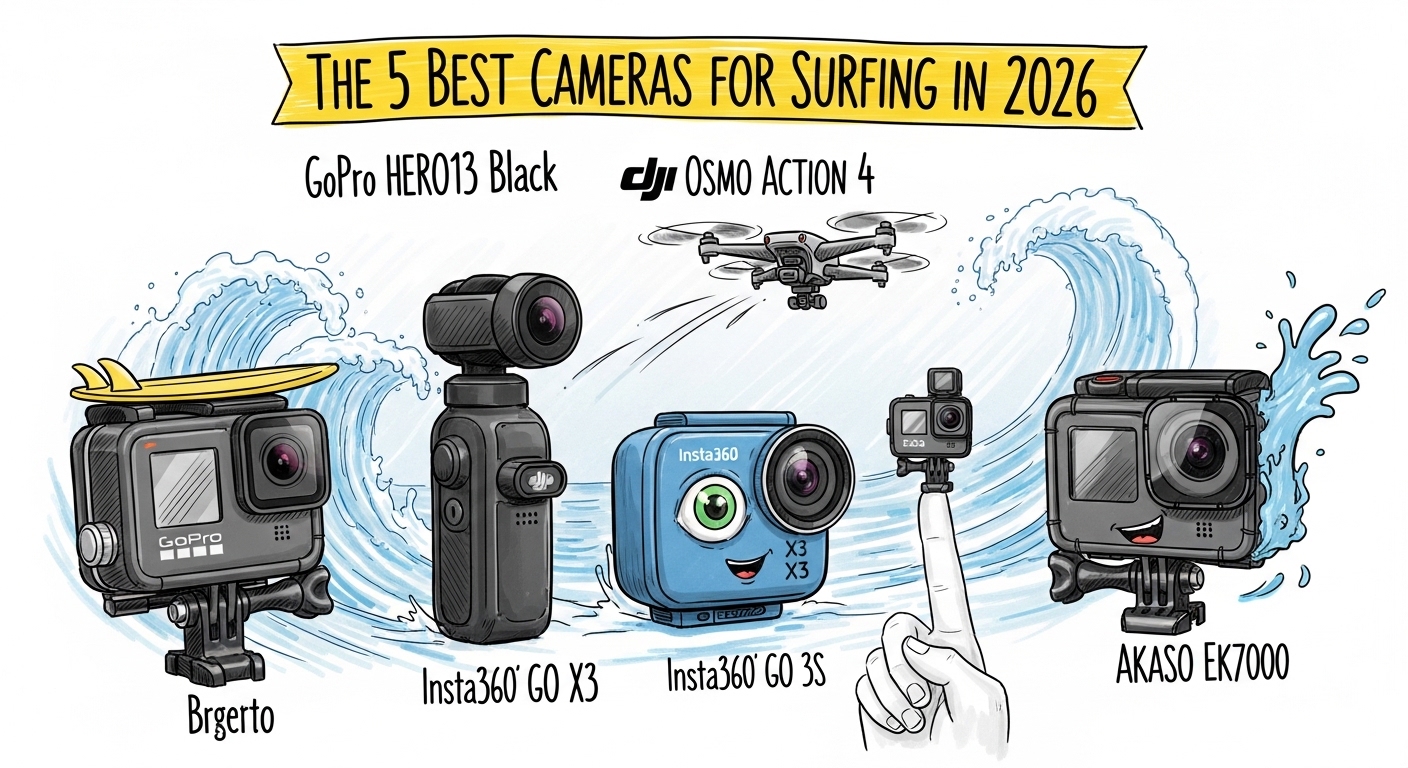
Quick Comparison: Top 5 Surf Cameras
| Camera | Resolution | Best For | Waterproof | Price | Buy on Amazon |
| GoPro HERO13 Black | 5.3K60 | Best overall surf camera | 33ft (10m) | 375$ | Buy on Amazon |
| DJI Osmo Action 4 | 4K120 | Best battery & low light | 33ft (10m) | 229$ | Buy on Amazon |
| Insta360 X3 | 5.7K 360 | Best 360° surf footage | 33ft (10m) | 299$ | Buy on Amazon |
| Insta360 GO 3S | 4K30 | Best compact / board mount | 33ft (10m) | 320$ | Buy on Amazon |
| AKASO EK7000 | 4K30 | Best budget surf camera | 131ft (40m) | 80$ | Buy on Amazon |
What Makes a Camera Good for Surfing
Not every waterproof camera cuts it in the surf. Here are the specific features that matter when you’re choosing a camera for ocean use:
- Waterproofing without housing: The best surf cameras are waterproof to at least 33ft (10m) without needing a separate underwater housing. Getting dunked during a wipeout, caught inside a set, or washed off your board is normal — your camera needs to handle it without extra accessories.
- Electronic Image Stabilisation (EIS): Surfing creates constant vibration, impact, and movement. A camera without strong stabilisation produces shaky, unwatchable footage. Look for dedicated EIS systems like GoPro’s HyperSmooth or DJI’s RockSteady — these are the industry benchmarks.
- Wide-angle lens: Surf footage requires a wide field of view — typically 140° or more — to capture the full wave, the surfer, and the surrounding ocean in a single frame. Narrow lenses miss too much of the action.
- Mounting versatility: The best surf cameras work mounted to a surfboard, a selfie stick, a helmet, or set up on a beach tripod. GoPro-compatible mount systems are the universal standard — every camera on this list uses compatible mounting points.
- Battery life: A surf session runs 1.5–3 hours. Your camera needs to last the full session or have easily swappable batteries. Look for cameras with rated battery lives above 90 minutes at full resolution, or models that support battery packs.
- Fast, intuitive controls: You need to be able to start and stop recording with one hand — often while paddling, wearing a wetsuit, and squinting into the sun. Touch screens and voice control are genuine advantages in the surf.
Surf photography and videography is a discipline in its own right. If you’re interested in how professional surf photographers approach their craft, our guide to the history of surf culture covers how surf imagery has shaped the sport’s identity from the earliest days of wave riding to the social media era.
1. GoPro HERO13 Black — Best Overall Surf Camera
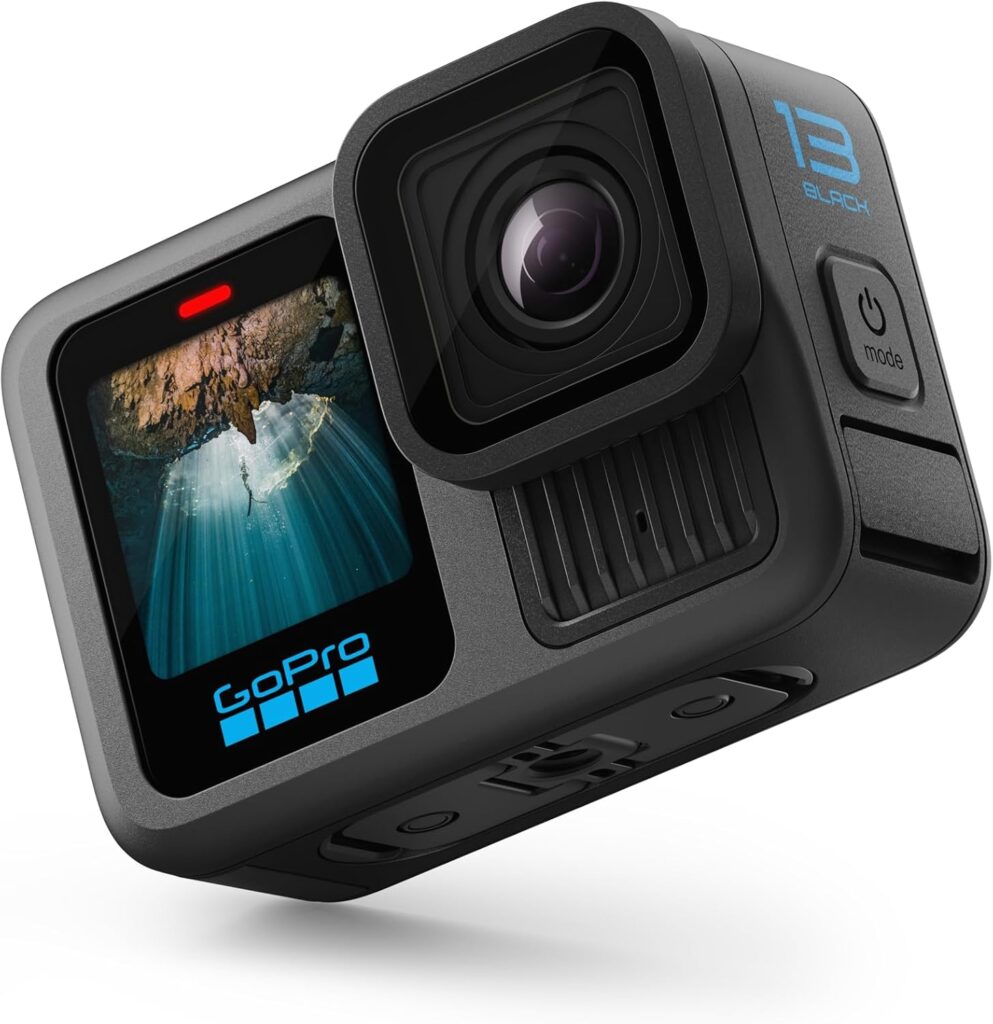
The GoPro HERO13 Black is the most complete surf camera on Amazon and the benchmark every other action camera is measured against. With 5.3K60 video, 27MP photos, HyperSmooth 6.0 stabilisation, native waterproofing to 33ft (10m), and an ecosystem of surf-specific mounts and accessories built up over years, the HERO13 is the camera that pro and amateur surf photographers reach for first.
Why It’s the Best for Surfing
HyperSmooth 6.0 is the best in-camera stabilisation system available on any action camera. Even mounted on a surfboard bouncing through chop, the footage comes out smooth and watchable. The dual LCD screens — front and rear — mean you can frame shots from any angle without guessing. The HERO13 also supports HB-Series Lens Mods, which allow you to swap between ultra-wide, anamorphic, and macro lenses, giving you creative flexibility no other surf camera on this list can match.
Key Features
- 5.3K60 video / 27MP photos — highest resolution on this list
- HyperSmooth 6.0 + AutoBoost — best stabilisation in its class
- Waterproof to 33ft (10m) natively — no housing needed
- Dual front/rear LCD screens — easy framing from any angle
- HB-Series Lens Mod support — swappable lenses for creative flexibility
- Voice control — start and stop recording hands-free in the lineup
Who Is It For?
The GoPro HERO13 is the pick for any surfer who wants the best footage quality and the most versatile surf camera system available. It’s ideal for surfers who want to self-film from the board, film from the beach with a zoom lens mod, or use it as part of a multi-camera setup. The price is higher than other options on this list, but the image quality, stabilisation, and ecosystem justify it for serious surf content creators.
Getting the best footage from a board-mounted camera also requires understanding how to read the break and position yourself for the best waves. Our surfing wave forecast guide will teach you to read swell direction, period, and bank conditions so you know where the best-lit, best-shaped waves will be — and where to set up your camera.
2. DJI Osmo Action 4 — Best Battery Life & Low Light
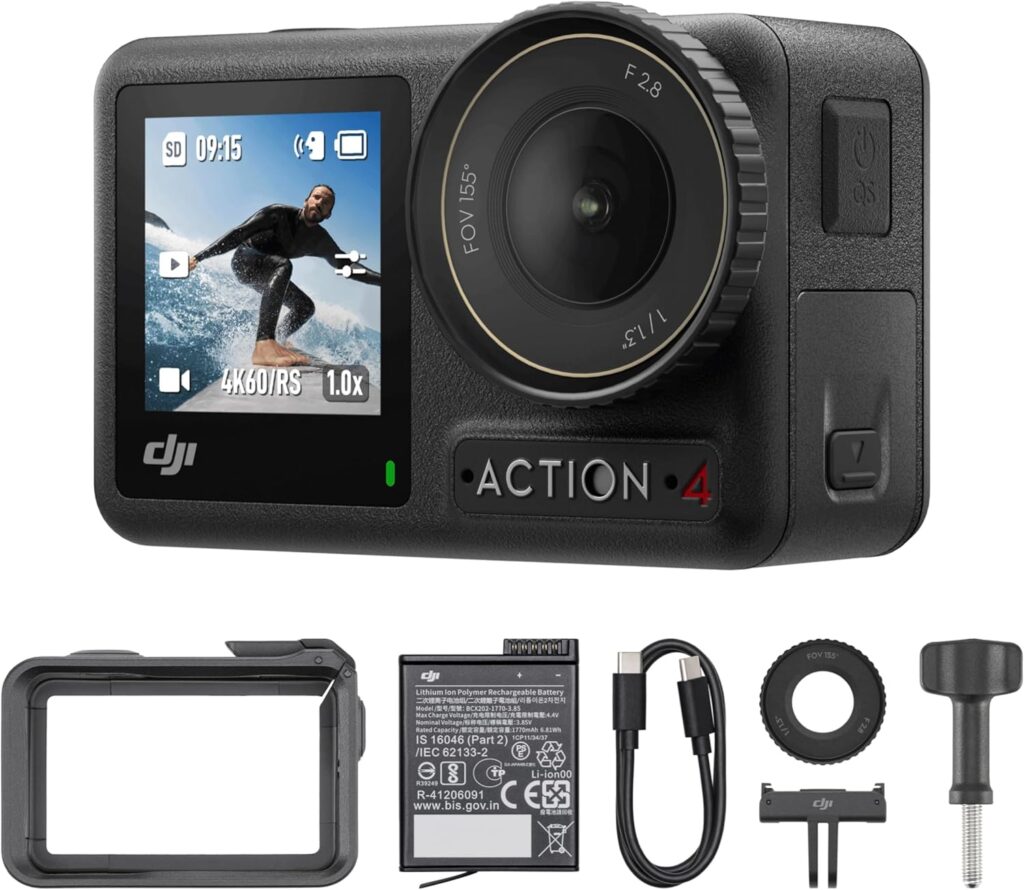
The DJI Osmo Action 4 is GoPro’s strongest competition on Amazon and the best action camera for surfers who prioritise battery life and low-light performance. With a 1/1.3-inch sensor — the largest on this list — 4K120fps video, RockSteady 3.0 stabilisation, and a rated battery life of 160 minutes at 4K30fps, the Osmo Action 4 outlasts every other camera here in terms of session endurance.
Why It’s Great for Surfing
The 1/1.3-inch sensor captures significantly more light than the smaller sensors in competing cameras, which translates directly to better footage in the low-contrast conditions common in surf photography — overcast skies, backlit waves, and the golden hour sessions that produce the most dramatic surf footage. The magnetic quick-release mounting system is faster to operate than traditional screw mounts, which is a genuine practical advantage when rigging and de-rigging your board between sessions.
Key Features
- 1/1.3-inch sensor — best low-light performance on this list
- 4K120fps video — ultra-slow motion wave breakdown at full 4K quality
- 160-minute battery life at 4K30fps — outlasts a full surf session
- RockSteady 3.0 + HorizonSteady — smooth footage even in heavy conditions
- Magnetic quick-release mount — faster rigging and de-rigging
- Waterproof to 33ft (10m) natively — no housing needed for surf use
Who Is It For?
The DJI Osmo Action 4 is the right pick for surfers who do early morning or late evening sessions where light is limited, or who regularly surf for 2+ hours and don’t want to interrupt a session to swap batteries. It’s also the stronger choice for surfers who want true 4K120fps slow motion for wave analysis and highlight edits — the GoPro HERO13 requires dropping to 2.7K for 240fps, while the Osmo stays at full 4K quality at 120fps.
Early morning and late evening sessions are when surf conditions are often cleanest — offshore winds, glassy water, and the best light for photography. Our essential surfing safety tips cover what you need to know about surfing in low-light and dawn patrol conditions, from visibility to rip current awareness.
3. Insta360 X3 — Best 360° Surf Camera
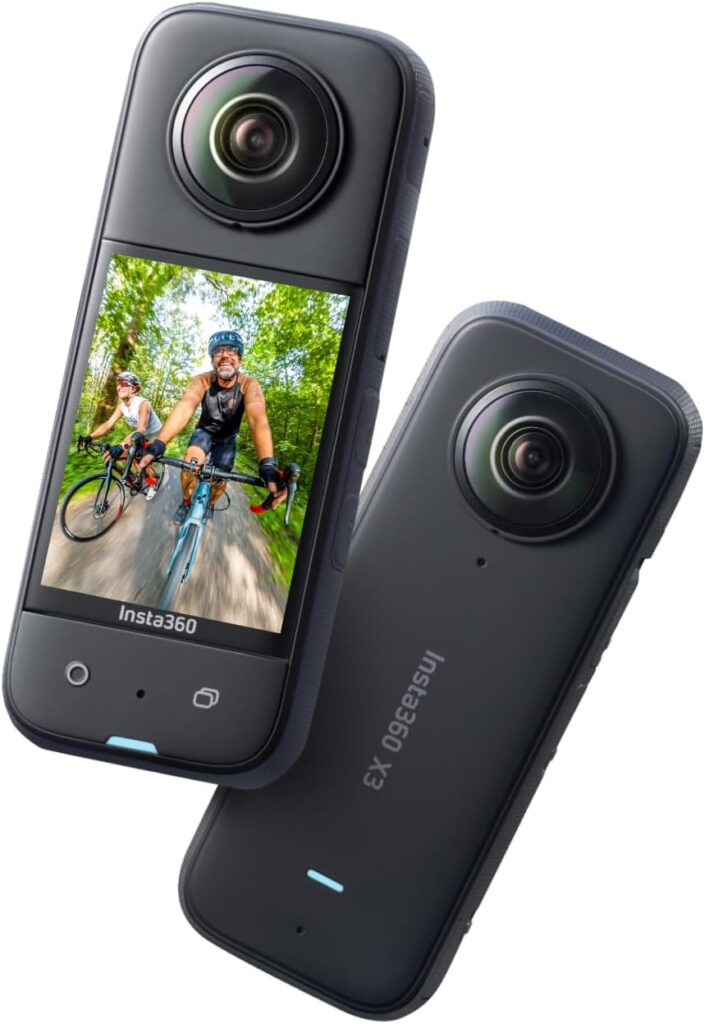
The Insta360 X3 is a completely different type of surf camera. Rather than pointing in one fixed direction, it shoots 360° footage — capturing the full sphere around the camera simultaneously. In surf use, this means you can mount it to your board on an extended stick, shoot everything, and decide later exactly which angle and framing you want to use. It’s the most creative tool on this list and produces footage and photos no standard action camera can match.
Why It’s Great for Surfing
The “invisible selfie stick” effect is the headline surf feature. Mount the X3 on a monopod, and Insta360’s software removes the stick from the footage entirely in post — leaving you with a floating, cinematic perspective that looks like drone footage shot from right next to the action. The 5.7K 360-degree video gives you enough resolution to reframe any part of the shot in standard widescreen, and the 2.29-inch touchscreen makes on-camera editing genuinely usable.
Key Features
- 5.7K 360° video — capture every angle simultaneously
- Invisible selfie stick effect — cinematic floating POV in post-processing
- 48MP 360° photos — reframe any moment into any perspective
- 4K single-lens mode — use as a standard action camera when needed
- IPX8 waterproof to 33ft (10m) — native surf-safe waterproofing
- AI editing in Insta360 app — automatic highlight reels from your footage
Who Is It For?
The Insta360 X3 is the pick for surfers who want creative, unique footage that stands out from standard GoPro-style board clips. It’s particularly powerful for surfers who post content online and want a distinctive visual style — the 360° perspectives and invisible stick effect look genuinely different from conventional surf footage. It also works as a standard wide-angle action camera in single-lens mode, making it a versatile two-in-one option.
Surf videography and photography has become a core part of surf culture — from sharing sessions with friends to building a social media presence around the sport. For context on how visual storytelling has always been central to surfing’s identity, our article on surfing’s mental health benefits touches on the community and creative dimensions of surf culture that go beyond simply riding waves.
4. Insta360 GO 3S — Best Compact Surf Camera
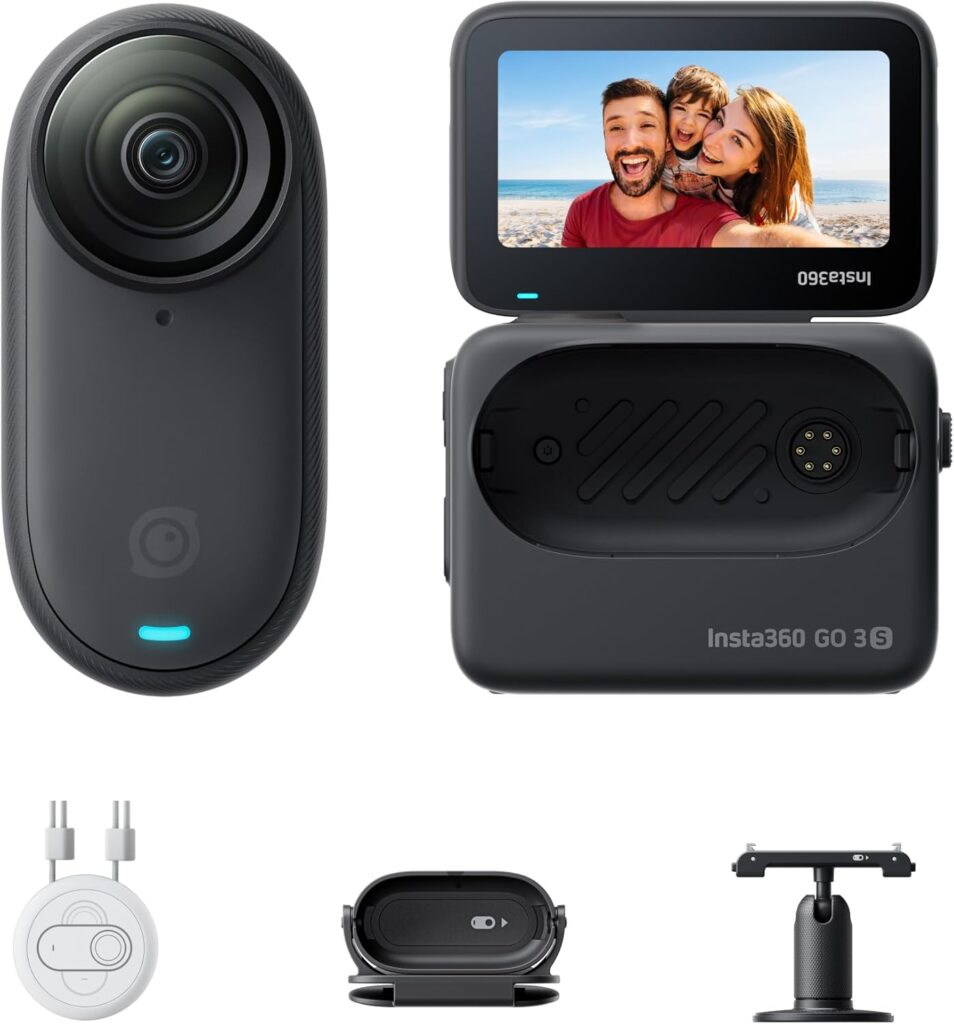
The Insta360 GO 3S is the smallest camera on this list and one of the most innovative action cameras on Amazon. At just 35 grams, it’s a tiny, magnetic, clip-anywhere camera that shoots 4K video and is waterproof to 33ft (10m) natively. For surf use, its compact size opens up mounting angles that are impossible with bulkier cameras — fin box mounting, rail mounting, close-up nose perspectives — without adding noticeable drag to your board.
Why It’s Great for Surfing
The GO 3S’s tiny form factor is its defining advantage. Mounted close to the board surface — on the nose, the deck, or even inside the fin box with the right mount — it captures perspectives that a full-size GoPro or DJI camera cannot. The 140-minute battery life is strong for its size, and the AI-powered stabilisation handles board vibration and impact far better than its size suggests. The Action Pod case that comes in the bundle doubles as a handle, a stand, and a small screen for playback and control.
Key Features
- 35g ultra-compact body — smallest camera on this list, minimal board drag
- 4K30fps video — full 4K in a camera smaller than a thumb
- Waterproof to 33ft (10m) natively — no housing required
- 140-minute battery life — extended session recording
- Magnetic clip mount — attach to anything instantly, no tools needed
- AI FlowState stabilisation — smooth footage from ultra-compact body
Who Is It For?
The Insta360 GO 3S is the right pick for surfers who want unique, close-to-board angles that standard action cameras can’t achieve, or for surfers who want a camera so unobtrusive that it doesn’t change their surfing at all. It’s also a strong second camera choice — mount one GO 3S on the board and use a standard camera from the beach for multi-angle footage without needing a full film crew.
Compact cameras and creative mounting also work well on surf trips where you want to capture the lifestyle around the surfing — not just the waves themselves. Our guide to the best surfing destinations for beginners covers the most cinematic and beginner-friendly breaks in the world, where a compact camera setup will help you capture the full trip experience.
5. AKASO EK7000 — Best Budget Surf Camera
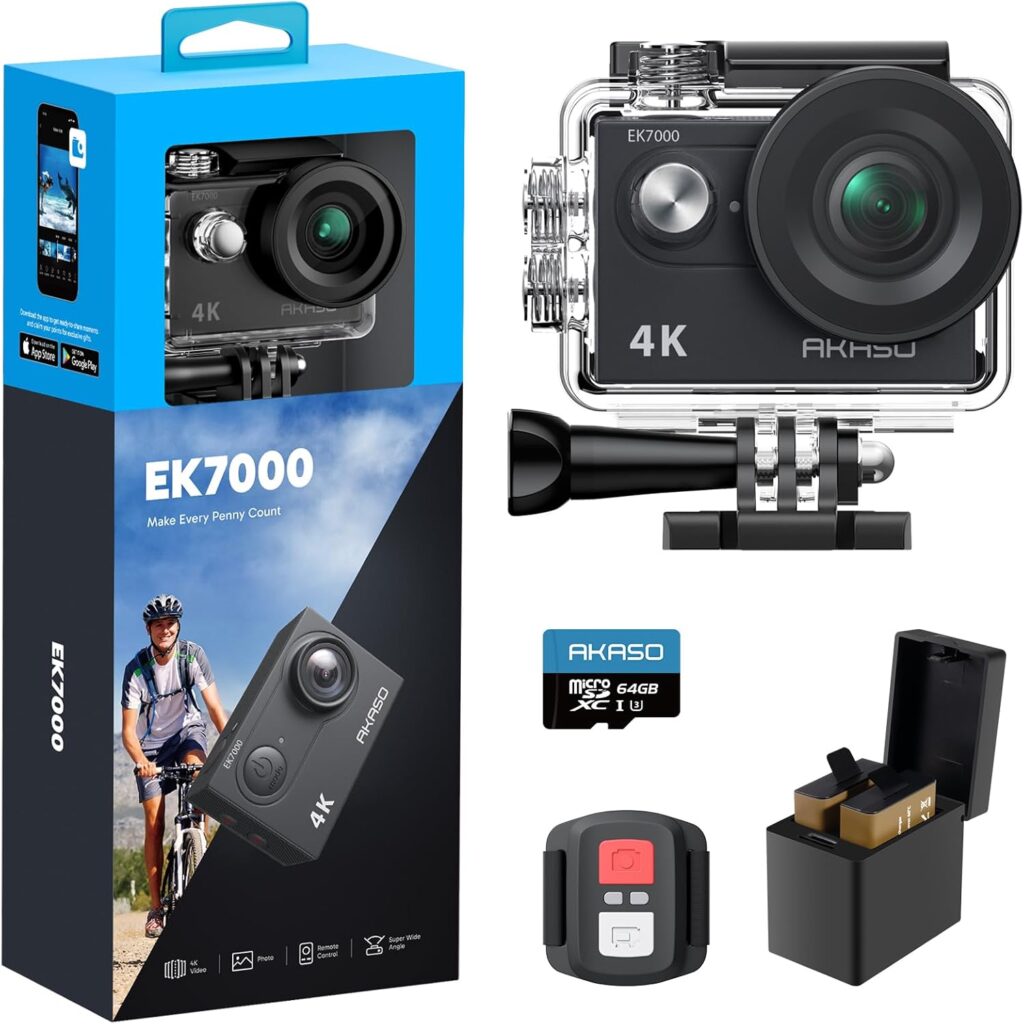
The AKASO EK7000 is the most affordable fully capable surf camera on Amazon and one of the best-selling action cameras on the platform. With 4K30fps video, 20MP photos, Electronic Image Stabilisation, native waterproofing to 131ft (40m) — deeper than any other camera on this list — WiFi connectivity, a wireless remote, and a GoPro-compatible mount system, it delivers the core surf camera feature set at a fraction of premium prices.
Why It’s Great for Surfing
The 131ft (40m) waterproofing is the standout spec — significantly deeper than the 33ft offered by GoPro, DJI, and Insta360. For surfers who regularly get pushed deep by wipeouts, or for underwater filming with a dive housing, this is a genuine advantage. The included wireless remote allows you to start and stop recording without touching the camera, which is particularly useful when it’s mounted out of reach on your board or a water housing pole. The GoPro-compatible mount system means you can use the same boards mounts, chest harnesses, and head straps as premium cameras.
Key Features
- 4K30fps video / 20MP photos — solid quality for the price
- Waterproof to 131ft (40m) natively — deepest waterproofing on this list
- EIS stabilisation — reduces shake in surf conditions
- 2.4G wireless remote included — start/stop recording hands-free
- WiFi + app connectivity — transfer and preview footage on your phone
- GoPro-compatible mount system — works with the full ecosystem of surf mounts
Who Is It For?
The AKASO EK7000 is the right pick for beginner surfers buying their first action camera, or for experienced surfers who want a backup camera for risky conditions where they’d rather not risk their primary camera. It’s also a strong choice for parents filming their kids learning to surf from the beach — the image quality is more than good enough for social sharing and personal memory keeping, at a price point that makes it easy to justify.
Beginner surfers who are just starting to document their progress will find the AKASO’s budget-friendly price a natural fit alongside a learning-appropriate board setup. Our guide to how long it takes to learn how to surf covers the full progression from first whitewash to green wave surfing — and having footage of your sessions is one of the most useful tools for accelerating that journey.
How to Choose the Right Surf Camera for Your Needs
The right surf camera depends on how you plan to use it. Here’s how to match each camera to your specific situation:
- For the best all-round footage quality: GoPro HERO13 Black. HyperSmooth 6.0 stabilisation, 5.3K resolution, and the most complete accessory ecosystem make it the benchmark choice for serious surf content.
- For early morning and long sessions: DJI Osmo Action 4. The largest sensor for low-light performance and the longest battery life mean it’s the strongest choice when conditions and session length push the limits of other cameras.
- For creative, unique footage: Insta360 X3. The invisible selfie stick effect and 360° reframing are impossible to replicate with standard cameras, and the AI editing tools make it the easiest camera to produce content-ready clips from.
- For close-to-board angles and minimal drag: Insta360 GO 3S. The smallest and lightest option on the list, capable of mounting positions no other camera on this list can achieve.
- For beginners and tight budgets: AKASO EK7000. GoPro-compatible mounts, deep waterproofing, a wireless remote, and 4K video at the lowest price point on the list — the best entry point to surf camera ownership.
Whatever camera you choose, make sure you understand the surf conditions you’ll be filming in. Our surfing wave forecast guide will help you read swell size, direction, and wind — so you know when conditions are photogenic and where to position yourself or your camera for the best angles.
How to Mount a Camera for Surfing
Where you mount your camera changes everything about the footage. Here are the most common and effective surf camera mounting positions:
- Nose mount: A suction cup or adhesive mount on the nose of the board points backward at the surfer. This is the classic POV perspective — you see the wave in front and the surfer’s hands and board behind. Works best on longboards with space at the nose.
- Tail / fin area mount: Mounted near the fins pointing forward at the surfer from behind. Gives a perspective looking up at the surfer and the wave face simultaneously — one of the most dramatic surf angles.
- Selfie stick / monopod: Hold the camera on an extended arm while surfing. Works best with the Insta360 X3’s invisible stick effect, which removes the arm entirely in post. Also effective held from the shore or a rock for filming others.
- Helmet mount: Less common in surfing than other action sports, but useful for SUP and bodyboarding where the head stays still enough for helmet footage to work.
- Beach tripod: Set up from the shore for filming others. Pair with a long lens or zoom capability for coverage of the full break. The GoPro Hero13 with a telephoto Lens Mod is the most capable beach setup on this list.
Surfing safety applies to your camera setup too — make sure any board mount is secure and won’t become a projectile in a wipeout, and always use a camera leash or float attachment. Our guide to essential surfing safety tips covers the safety practices every surfer should follow before adding equipment to their session.
Frequently Asked Questions
Can I use a GoPro in the ocean without a case?
Yes — all GoPro HERO models since the HERO5 Black are natively waterproof to 33ft (10m) without a housing. For recreational surfing, which rarely involves submersion beyond a few metres even during wipeouts, the native waterproofing is completely sufficient. If you’re planning to dive deeper or want extra protection for heavy impact conditions, an aftermarket dive housing extends waterproofing significantly.
What is the best way to mount a camera to a surfboard?
Adhesive suction cup mounts are the most popular option for surfboard mounting — they attach to the board deck without drilling or permanent modification, and the suction holds reliably in normal surf conditions. GoPro-compatible mounts work with every camera on this list. For nose mounting on a longboard or foam board, adhesive flat mounts create a permanent but very low-profile attachment point. Always use a camera leash as a safety backup. For more on board setup and equipment, our guide to choosing the right surfboard covers how board dimensions affect what mounting positions are practical.
Is the AKASO EK7000 as good as a GoPro for surfing?
Not quite — the GoPro HERO13’s stabilisation, colour science, and overall image quality are noticeably better. But for the price difference, the AKASO is a remarkably capable camera. For beginners who want to document their learning sessions, share clips on social media, or just see themselves surfing for the first time, the AKASO delivers fully usable 4K footage at a fraction of the premium camera price. It’s also the only camera on this list waterproof beyond 33ft without additional housing.
Do I need a waterproof camera specifically for surfing?
Yes, without exception. Even if you’re filming from the beach rather than in the water, spray, sand, and humidity in the surf zone will damage a non-waterproof camera quickly. All five cameras on this list are natively waterproof and built for salt water exposure. Standard digital cameras, DSLRs, and smartphones without a dedicated waterproof case are not appropriate for use in the surf zone.
What memory card should I use for a surf camera?
For 4K and above recording, use a UHS-I Speed Grade 3 (U3) or UHS Speed Class 10 (V30) microSD card — these have the minimum write speed needed to handle high-bitrate action camera footage without dropped frames. A 64GB card gives you approximately 2–3 hours of 4K footage depending on the camera. For 5.3K recording on the GoPro HERO13, a 128GB card is recommended for longer sessions. For more on the full kit list you need for a surf session, our guide to what to wear surfing covers everything from apparel to accessories.
Final Verdict: Best Cameras for Surfing in 2026
Here’s the quick breakdown by surfer type:
- Best overall: GoPro HERO13 Black — 5.3K video, HyperSmooth 6.0, the deepest accessory ecosystem, and the gold standard for surf content quality.
- Best for long sessions & low light: DJI Osmo Action 4 — 160-minute battery, 1/1.3″ sensor, 4K120fps. The camera that outlasts and out-performs in dawn patrol and evening sessions.
- Best for creative footage: Insta360 X3 — 360° video, invisible selfie stick, AI editing. Produces footage no other camera on this list can replicate.
- Best compact option: Insta360 GO 3S — 35g, magnetic clip, 4K. Unique close-to-board angles in the smallest possible package.
- Best budget pick: AKASO EK7000 — 4K, 131ft waterproofing, GoPro-compatible mounts. The strongest entry-level surf camera on Amazon.
Getting your surfing on camera is one of the most useful things you can do for your progression — seeing yourself from the outside reveals mistakes, improvements, and moments you’d never notice in the moment.
Before your next filmed session, make sure you’re checking conditions properly so your camera catches the best waves. Our surfing wave forecast guide will teach you to read the forecast so you’re set up for great surf — and great footage.