
Figuring out how to travel with a surfboard on a plane is one of the biggest challenges every traveling surfer faces. Between confusing airline policies, oversized baggage fees, and the ever-present risk of dings, planning a surf trip can feel more stressful than paddling into overhead sets. The good news is that several airlines have updated their surfboard policies heading into 2026, and with the right preparation you can get your board from point A to point B without breaking the bank or your rails.
Whether you are flying domestically to beginner-friendly surf destinations or heading overseas for a dream trip to Indo or Central America, this guide covers everything you need to know. We will walk through airline fees, board bag selection, packing techniques, and pro-level travel tips so you can focus on what matters most: scoring waves.
Why Bring Your Own Surfboard on a Plane?

Renting a board at your destination is always an option, but nothing beats riding the board you already know and trust. Your own surfboard is shaped to your weight, ability, and preferred wave type. If you have spent time choosing the right surfboard size, you understand how personal the connection between surfer and board really is.
Rental availability also varies wildly. Popular spots like Bali and Tamarindo tend to have solid quiver selections, while remote breaks may offer limited or poorly maintained options. Bringing your own board guarantees you are riding equipment that performs exactly the way you expect, whether it is a longboard for cruisy point breaks or a performance shortboard for punchy reef waves.
Airline Surfboard Fees and Policies in 2026
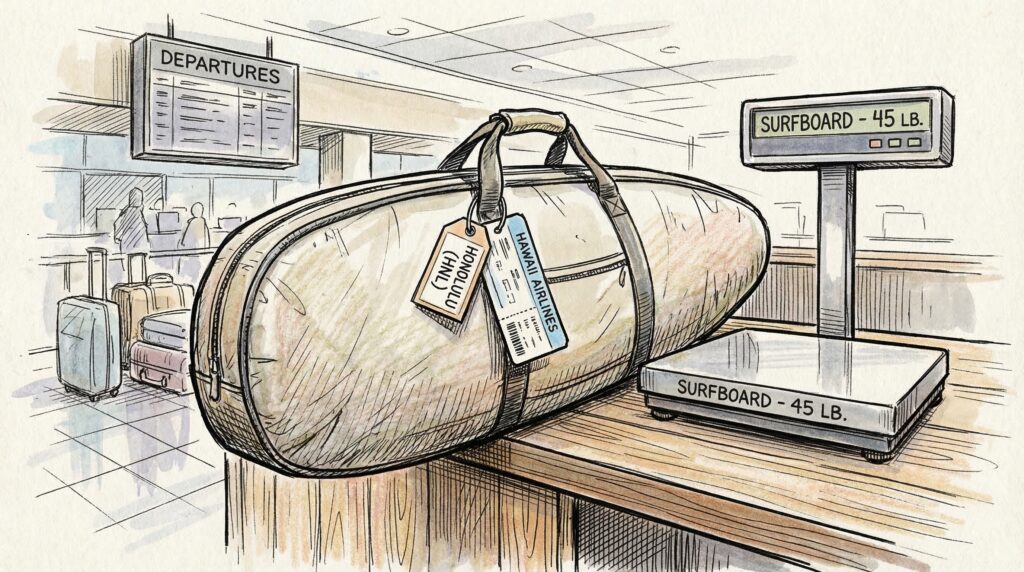
Airline surfboard policies change frequently, so always confirm fees directly with your carrier before booking. That said, 2026 has brought some positive shifts. Several major airlines now treat surfboard bags as standard checked luggage rather than oversized sporting equipment, which can save you significant money on every leg of your trip.
Surfer-Friendly Airlines
Alaska Airlines and Hawaiian Airlines introduced one of the most generous surfboard policies among U.S. carriers in late 2025. Surfboard bags are treated as standard checked baggage with no special item fees. Passengers can check multiple boards in a single bag measuring up to 10 feet 5 inches and weighing up to 50 pounds. On regional E175 aircraft, the limit drops to 9 feet 7 inches.
American Airlines also remains a solid choice. Surfboards incur standard checked bag fees as long as the total weight stays under 50 pounds and overall dimensions remain within 126 linear inches. You can pack multiple boards in one bag and it counts as a single checked item. Just make sure to remove fins and protect keels properly.
JetBlue treats board bags as checked luggage and exempts them from standard size requirements, meaning you will not face automatic oversize surcharges. Standard checked bag fees of up to 70 dollars apply depending on fare type and whether you prepay online.
Airlines That Charge More
United Airlines classifies surfboards as special items and charges between 150 and 200 dollars each way. Southwest charges 75 dollars per direction for surfboards as a substitute for one checked bag. Spirit Airlines charges a flat 100 dollars each way. International carriers like Aeromexico charge around 150 dollars per surfboard, while Copa charges between 100 and 150 dollars depending on route.
Budget airlines in Europe and Asia often have even stricter policies, so if you are planning a trip abroad, factor board bag fees into your total travel budget. Sometimes choosing a slightly more expensive flight with a surfer-friendly airline actually saves you money overall.
Key Tips for Avoiding Surprise Fees
Understanding linear inches is critical when evaluating airline size restrictions. Linear inches means length plus width plus height, not just the length of your board. A bag that is 79 inches long, 24 inches wide, and 12 inches deep totals 115 linear inches. Always measure your packed bag and compare it against the airline limit before heading to the airport.
Prepaying for your surfboard bag online can also save money. Many airlines offer discounted sports equipment fees when booked in advance versus at the counter. Print your confirmation and the airline’s published policy page in case of any disputes at check-in.
How to Choose the Right Surfboard Travel Bag
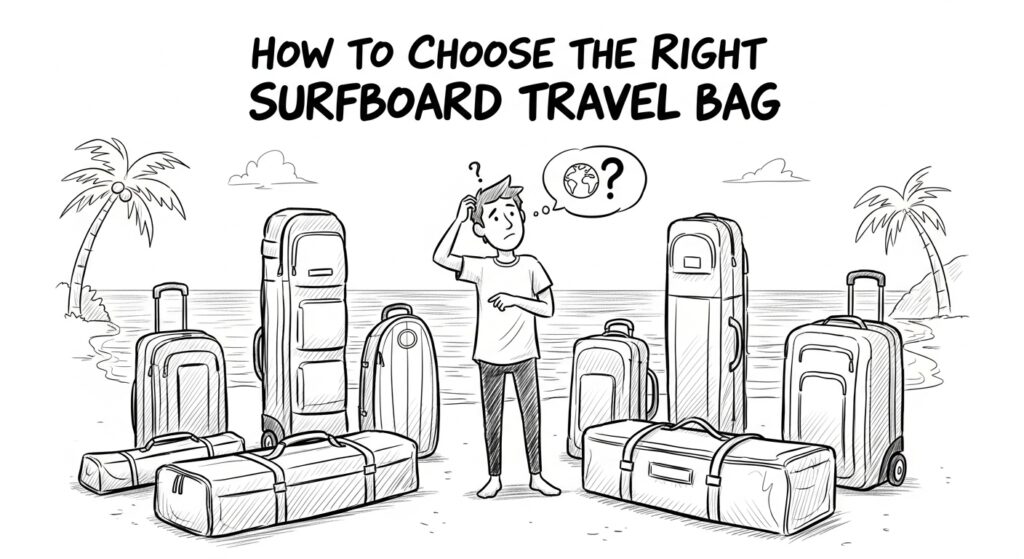
A quality travel board bag is the single most important investment you can make to protect your surfboard during air travel. There is a big difference between a lightweight day bag designed for beach runs and a padded travel bag built to survive baggage handlers.
Look for a bag with at least 10mm of padding throughout, reinforced nose and tail sections, internal tie-down straps, and a durable zipper system. If you are traveling with two boards, a coffin-style bag with wheels is the most practical option. Wheels positioned under the deck rather than the rail edge make it much easier to navigate airports.
Popular options from brands like FCS, Creatures of Leisure, Dakine, and VEIA offer solid protection across a range of price points. If you plan to take multiple surf trips per year, investing in a heavier duty bag will pay for itself in avoided ding repairs. Speaking of which, knowing how to handle eco-friendly board repairs is always useful for the minor damage that can happen even with the best protection.
Step-by-Step Guide to Packing Your Surfboard for a Plane
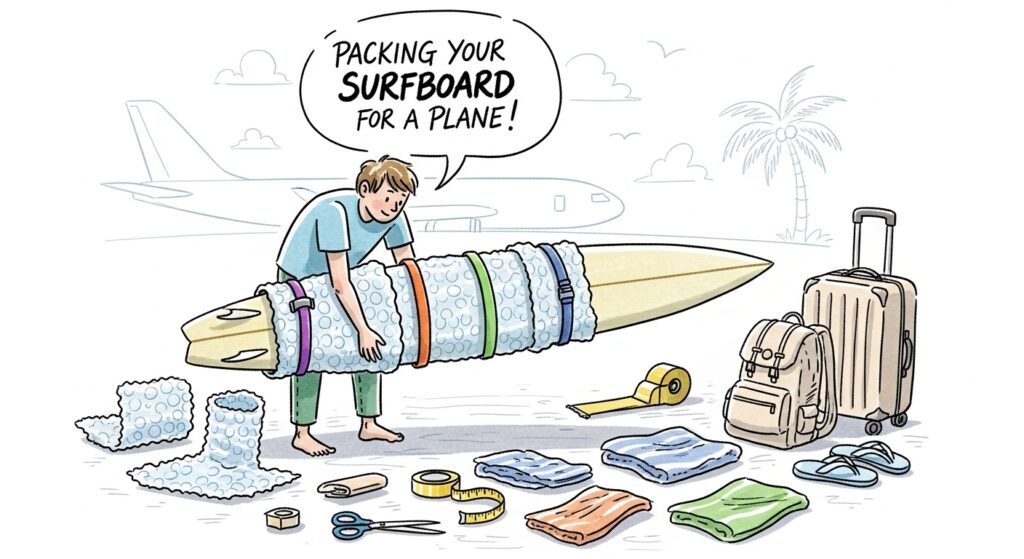
Proper packing is where most of the damage prevention happens. Follow these steps to give your board the best chance of arriving in one piece.
Step 1: Inspect and Prep Your Board
Before packing, inspect your surfboard for existing dings, cracks, or pressure marks. Repair any damage before your trip so you do not worsen it during transit. Remove all fins and store them separately. A flat board sits more securely in the bag and presents fewer contact points that could cause cracking.
You should also strip the old wax off your board. On long flights, especially to tropical destinations, heat in the cargo hold can melt wax and create a sticky mess inside your bag. If you want to learn more about wax and why it matters, check out our guide on why surfers wax their surfboards.
Step 2: Protect Rails, Nose, and Tail
The nose, tail, and rails are the most vulnerable areas of your board during transit. Use polyethylene foam pipe insulation, available at any hardware store for just a few dollars, and slide it over the entire length of the rails. Cut additional pieces for the nose and tail, layering extra padding in these high-impact zones.
Secure the pipe insulation with masking tape rather than duct tape, which can leave sticky residue on your board. Some surfers also cut cardboard to match the outline of their board and place it on the deck and bottom for additional impact absorption.
Step 3: Layer and Strap Inside the Bag
Place your largest board on the bottom of the bag, deck facing up. If you are stacking two boards, position the second one on top with the deck facing down so the decks rest against each other. Use any internal tie-down straps to secure the boards and prevent shifting during transit.
You can tuck your surfing wetsuit and a towel around the boards for extra cushioning, but keep the total weight in mind. A heavy bag is more likely to be tossed roughly by handlers. Aim to strike a balance between padding and portability.
Step 4: Final Checks Before Zipping Up
Wrap your fins in a soft cloth or bubble wrap and tuck them into a pocket or the empty space near the tail. Place any leashes, surf apparel, and small accessories in the remaining gaps. Weigh your bag at home using a luggage scale to make sure you are under the airline limit.
Consider placing an AirTag or GPS tracker inside your board bag. This lets you monitor your bag in real time and gives you peace of mind during layovers and connections.
Pro Tips for Traveling With a Surfboard on a Plane
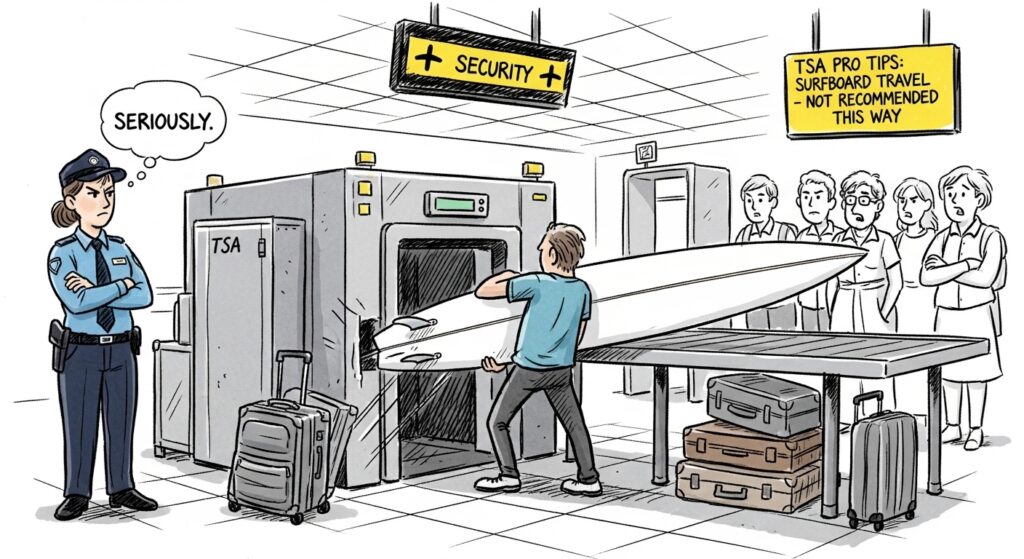
Even experienced traveling surfers pick up new tricks with every trip. Here are a few strategies that can make the entire process smoother.
Book direct flights whenever possible. Every connection means another opportunity for your board bag to be mishandled or lost. If a direct route is not available, choose layovers with longer connection times so your oversized luggage has time to transfer.
Be friendly at the check-in counter. The agent handling your bag has a lot of discretion. Have your documents ready, smile, and ask about their day. Surfers who come across as organized and pleasant tend to receive better treatment when it comes to borderline weight or size situations.
Use a fragile sticker. Ask the airline to tag your board bag as fragile. While there is no guarantee this changes handling, many surfers report that fragile-tagged bags tend to be loaded on top of the pile rather than buried underneath heavy luggage.
Wrap zippers with plastic wrap. A few layers of recycled cling wrap around the zipper ends adds water resistance and makes it harder for bags to be opened during transit. It is a cheap security measure that takes less than a minute.
Should You Get Surfboard Travel Insurance?
Airlines accept surfboards at your own risk, and most standard travel insurance policies exclude sporting equipment or cover it at very low limits. Dedicated surfboard insurance or a specialized sports equipment rider can cover ding repairs, full board replacement, and even trip interruption if your board arrives damaged beyond use.
Companies like Thimble, Oyster, and World Nomads offer policies tailored to surf travelers. The cost is typically modest, anywhere from 30 to 100 dollars per trip depending on the value of your quiver. If you are traveling with a custom board worth several hundred dollars, insurance is well worth the small premium.
Planning Your Surf Trip Around Board-Friendly Airlines
Smart trip planning starts with working backward from airline routes and surfboard policies. If Alaska Airlines flies to your destination, that is often the cheapest way to get your board there. For trips to Hawaii, Tahiti, or the West Coast, the Alaska and Hawaiian Airlines combo is hard to beat.
For Central American destinations like Nicaragua and Costa Rica, American Airlines and JetBlue tend to offer the best combination of affordable fares and reasonable surfboard fees. European carriers like Air France and KLM include surfboards in the standard checked bag allowance on many routes, which is ideal for trips to Morocco, Portugal, or the Canary Islands.
Before booking, spend time reading surf forecasts for your target dates so you can align favorable swell windows with the best flight deals. Planning around both surf conditions and airline policies is the key to a successful trip. And if you are still building your skills, understanding how long it takes to learn to surf can help you set realistic expectations for your adventure.
What Else to Pack for a Surf Trip
Beyond the board itself, a well-planned surf trip requires the right gear. Your surfing fitness routine should be in full swing before departure so you can maximize time in the water. Bring reef-safe sunscreen, a first aid kit, and enough wax for the water temperature at your destination.
If you are heading somewhere with cooler water, pack a wetsuit that matches the water temperature at your destination. For tropical trips, lightweight boardshorts and a quality rash guard are usually all you need.
Do not forget to review essential surfing safety tips before you paddle out at an unfamiliar break. Understanding local hazards like currents, rocks, and crowded lineups is just as important as having the right board under your feet.
When to Rent Instead of Bringing Your Board
Sometimes renting makes more sense than flying with your own equipment. If you are a beginner still experimenting with different shapes, renting lets you try a range of boards without the hassle of air travel. Our guide to the best surfboards for beginners can help you narrow down what styles to look for when you arrive.
Renting also makes sense when you are taking short trips of three days or less, flying on airlines with exceptionally high fees, or visiting destinations with excellent rental shops. Many surf towns in Bali, Costa Rica, and Portugal have high-quality rental options at affordable daily rates.
That said, if you are an intermediate or advanced surfer heading on a week-long trip, bringing your own board almost always pays off in both performance and satisfaction. The deep history of surf culture is built on the bond between surfer and board, and nothing replicates the feeling of dropping into a perfect wave on a board you know inside and out.
Common Mistakes When Flying With a Surfboard
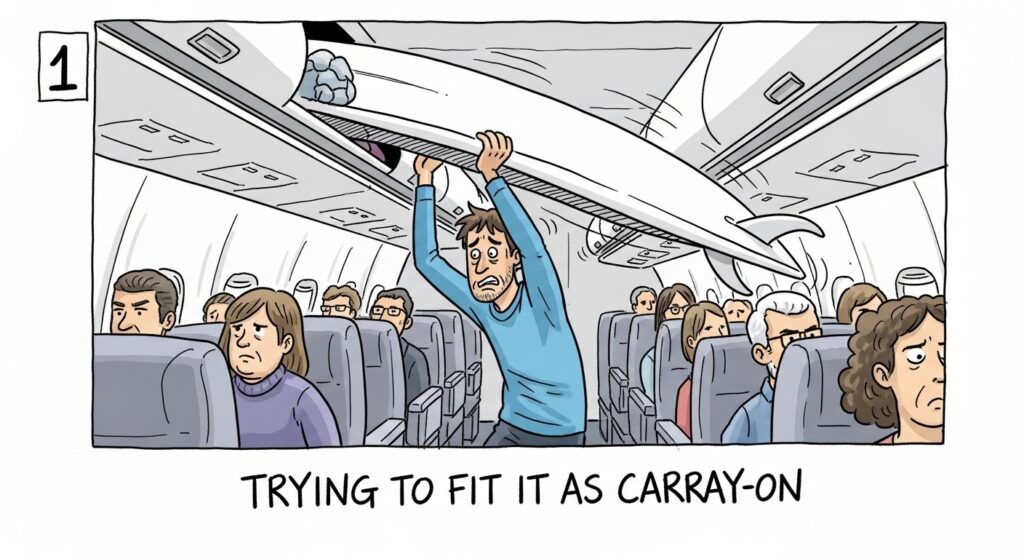
Even seasoned travelers make errors. Here are the most common pitfalls and how to avoid them.
Not checking airline policy before booking. Airline surfboard rules change often. Always verify fees, weight limits, and size restrictions on the carrier’s official website and call to confirm if anything seems unclear.
Leaving fins attached. Protruding fins create pressure points inside the bag and are one of the leading causes of rail and bottom damage during transit. Always remove them.
Overpacking the board bag. Stuffing too many clothes and gear into the bag increases weight and can push you over the limit, triggering overweight surcharges. Keep the bag streamlined and pack clothes in your regular suitcase instead.
Skipping the weigh-in at home. There is nothing worse than arriving at the airport and discovering your bag is five pounds over the limit. A simple luggage scale eliminates this risk entirely.
Additional Resources for Traveling Surfers
A great surf trip involves more than just getting your board there safely. Staying in peak physical shape makes a huge difference, so explore our guide to surfing’s mental health benefits to understand how time in the ocean improves your overall well-being.
If you are stuck on land during a layover or weather delay, the best surfing movies are the perfect way to stay stoked. And for travelers curious about crossover sports, you might enjoy reading about how surfing compares to snowboarding and what skills transfer between the two.
Final Thoughts on How to Travel With a Surfboard on a Plane
Learning how to travel with a surfboard on a plane takes a bit of research and preparation, but it is well worth the effort. With the right board bag, a solid packing method, and an understanding of airline policies in 2026, you can arrive at your destination with your board intact and your wallet in decent shape.
Start by choosing an airline with surfer-friendly policies, invest in a quality travel bag, and follow the step-by-step packing process outlined above. Do your homework before every trip, and do not hesitate to call the airline directly to confirm their current rules. Surf travel should be exciting, not stressful, and proper planning is the difference between a dream session and a nightmare at baggage claim.