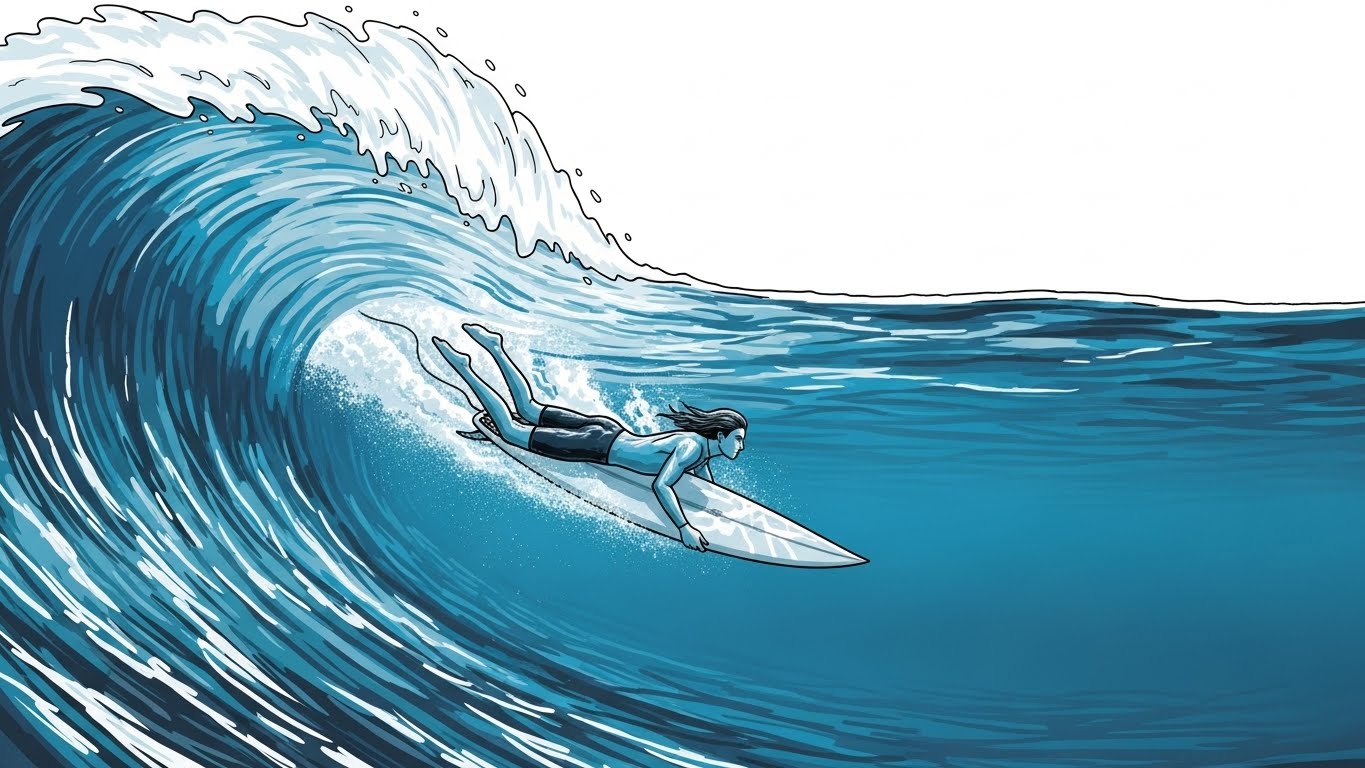

Learning how to duck dive is one of the most crucial skills every surfer needs to master when progressing beyond the beginner stage. This powerful technique allows you to push your surfboard underwater and pass beneath breaking waves, conserving energy and maintaining your position in the lineup.
Whether you’re transitioning from a longboard to a shortboard or simply want to paddle out more efficiently, understanding the mechanics of duck diving will transform your surfing experience.
Duck diving gets its name from the way ducks submerge themselves underwater—quickly, smoothly, and with purpose. For surfers, this technique becomes essential when waves are too powerful to simply paddle over or push through.
Instead of getting pushed back to shore by whitewater or fighting against the wave’s force, a proper duck dive lets you slip beneath the turbulence and continue your journey to the lineup with minimal effort.
In this comprehensive guide, we’ll break down everything you need to know about duck diving, from the fundamental mechanics to advanced tips that will help you execute perfect duck dives in various conditions.
Whether you’re a beginner wondering if you’re ready to learn this skill or an intermediate surfer looking to refine your technique, this article will provide the knowledge and practical steps you need to succeed.
Understanding the Duck Dive Fundamentals
Before attempting your first duck dive, it’s important to understand what makes this technique work. Duck diving relies on physics, timing, and board control. The goal is to push both yourself and your surfboard deep enough underwater that the wave’s turbulent energy passes over you without dragging you backward.
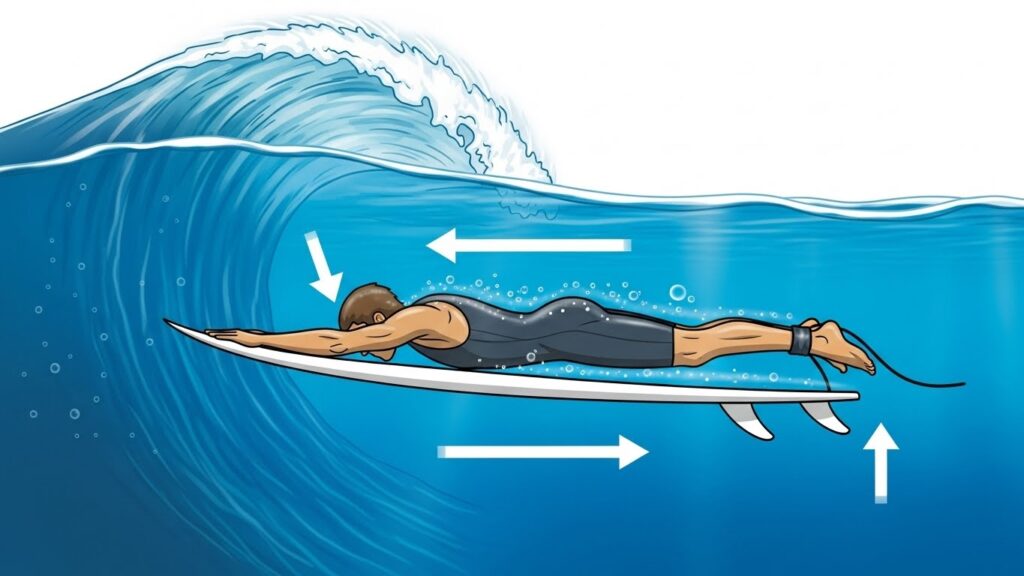
The technique involves using your body weight to submerge the nose of your surfboard, then using your foot or knee to push down the tail, creating a scooping motion that takes you beneath the wave. As the wave passes overhead, you angle the nose of your board back toward the surface and emerge on the other side, ready to continue paddling.
Key factors that affect duck diving success:
- Board volume and size – Smaller boards with less buoyancy are easier to push underwater
- Wave size and power – Larger waves require deeper, more aggressive duck dives
- Timing – Starting your duck dive too early or too late significantly reduces effectiveness
- Speed – Maintaining paddle speed before the dive helps with momentum
- Body positioning – Proper weight distribution determines how deep you can push the board
Understanding that duck diving is primarily a technique for shortboards and smaller boards is crucial. If you’re currently riding a longboard, you’ll need to learn alternative techniques like the turtle roll. To learn more about different board types and their characteristics, check out this guide on choosing the right surfboard size.
Is Your Board Suitable for Duck Diving?
Not all surfboards can be duck dived effectively. The primary determining factor is board volume and buoyancy. Generally speaking, boards with volumes above 40-45 liters become increasingly difficult to submerge, and anything approaching 60+ liters is nearly impossible for most surfers to duck dive properly.
Boards that work well for duck diving:
- Shortboards (typically 5’6″ to 6’6″)
- Performance fish designs with moderate volume
- Step-up boards for bigger waves
- High-performance hybrids under 40 liters
Boards that are challenging or impossible to duck dive:
- Longboards (9’0″ and above)
- Funboards and mini-mals (7’0″ to 8’6″)
- High-volume grovelers designed for small wave performance
- SUPs and other large-volume watercraft
If you’re currently learning to surf on a beginner-friendly board with high volume, don’t worry—this is actually the right approach for building fundamental skills. Most surf instructors recommend starting with boards that are easier to paddle and catch waves on. You can explore the best surfboards for beginners to understand which board type matches your current skill level.
As you progress and develop better wave judgment, paddling fitness, and overall board control, transitioning to a lower-volume board will make duck diving possible. Many intermediate surfers make this transition after six months to a year of consistent practice.
Step-by-Step Guide: How to Duck Dive Properly
Now let’s break down the actual technique into manageable steps. Mastering how to duck dive requires practice, but understanding the proper sequence will accelerate your learning curve dramatically.
Step 1: Build Momentum with Strong Paddling
Begin by paddling toward the approaching wave with strong, purposeful strokes. Speed is your ally here—the faster you’re moving, the easier it becomes to punch through the wave. Don’t slow down as you approach; instead, take three to four powerful paddle strokes right before you initiate the dive.
Your timing should position you about 6-10 feet away from the wave when you begin the duck dive sequence. Too close and you won’t have time to get deep enough; too far and you’ll lose the momentum needed to push through effectively.
Step 2: Grip the Rails and Push the Nose Down
As the wave approaches, grip the rails of your surfboard firmly about 12-18 inches back from the nose. Your hands should be slightly wider than shoulder-width apart, positioned where you can generate maximum downward force.
Using your upper body strength and core muscles, push the nose of the board downward into the water. This is where arm strength and technique combine—you want to drive the nose down quickly and decisively. Your chest should come close to the deck of the board as you push down, almost like you’re doing a push-up motion combined with a downward press.
Step 3: Use Your Foot or Knee to Submerge the Tail
Once the nose is underwater and you’ve pushed your upper body down, it’s time to submerge the tail. This is the critical moment that separates a shallow, ineffective duck dive from one that gets you beneath the wave’s power.
Place your foot (for shortboards) or knee (for slightly larger boards) on the tail pad or back section of the board. Push down firmly and quickly. This action creates a scooping motion, taking both you and your board deeper underwater at an angle.
Many beginners struggle with this step because they don’t push down aggressively enough. The tail needs to go underwater—not just dip slightly below the surface. Commit to the push and trust that the board will follow through.
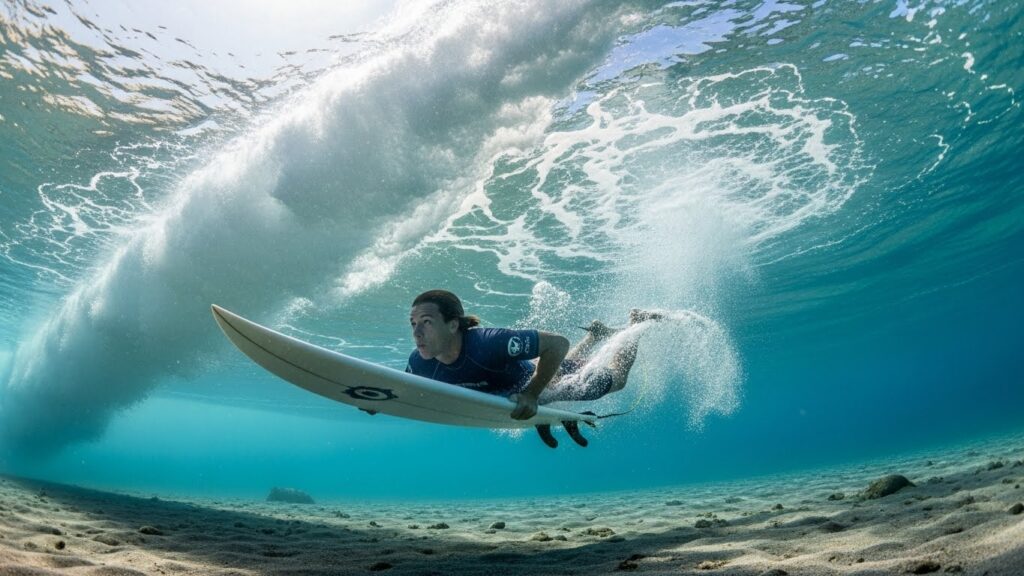
Step 4: Streamline Your Body and Level Out
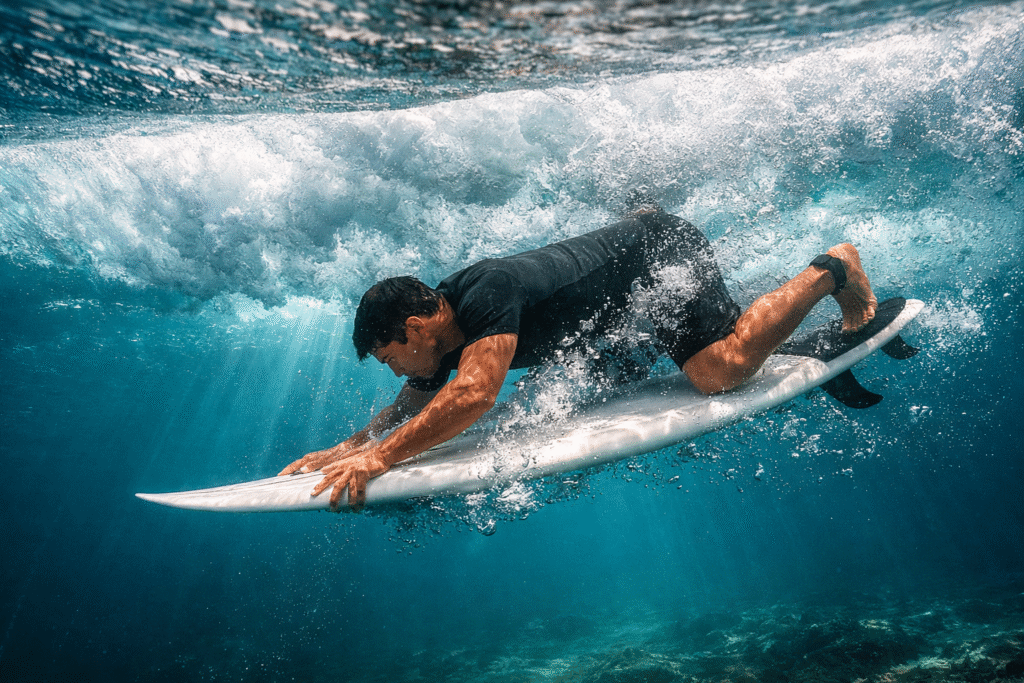
As you’re fully submerged, pull yourself close to your board and streamline your body. Think of yourself as an arrow cutting through the water. Keep your arms extended and your body compact to minimize resistance.
The wave will pass overhead, and you’ll feel its energy pushing down on you. This is normal—resist the urge to panic or surface early. Instead, maintain your streamlined position and wait for the pressure to release.
As the wave passes, begin to level out your board or even angle the nose slightly upward. This helps you emerge on the other side of the wave rather than being held down.
Step 5: Resurface and Resume Paddling
Once the wave has passed, use the natural buoyancy of your board to pop back to the surface. Pull yourself onto the board quickly and immediately resume paddling. The key here is to not waste time—if another wave is coming, you need to regain your speed and prepare for another duck dive.
Your first few breaths after surfacing might be gasping—this is normal as you build the paddling fitness and breath control needed for repeated duck dives. Regular training will improve your surfing fitness and make the process feel less exhausting over time.
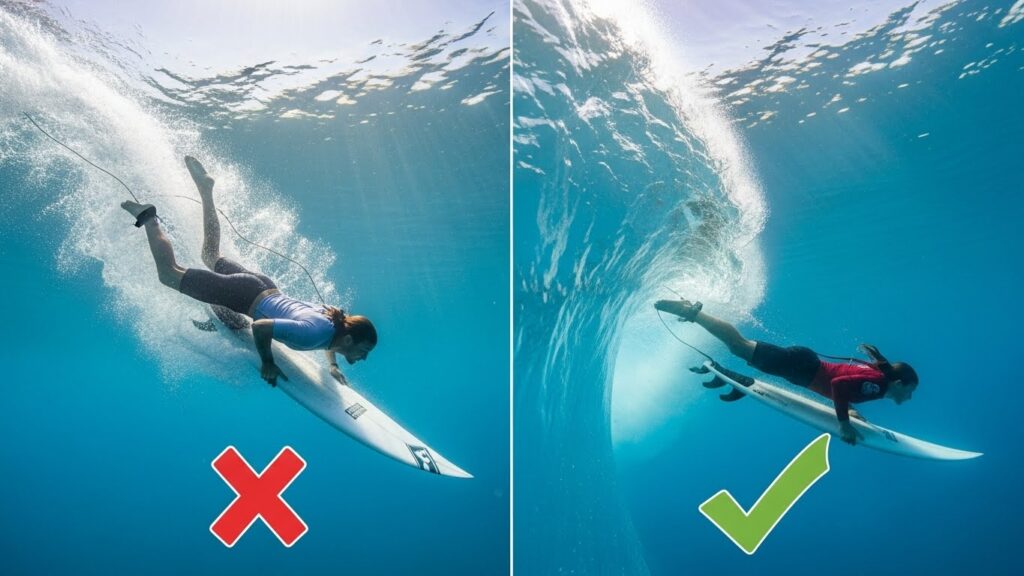
Common Duck Diving Mistakes and How to Fix Them
Even experienced surfers sometimes struggle with duck diving in certain conditions. Here are the most common mistakes and their solutions:
Mistake 1: Starting too late or too early
If you start your duck dive too late, you’ll get caught in the whitewater and pushed backward. Start too early, and you’ll surface right as the wave hits you. The solution is practice and wave-reading experience. Aim to begin your dive when you’re about 6-10 feet from the wave, adjusting based on wave size and speed.
Mistake 2: Not pushing down hard enough
Timid duck dives result in shallow submersion, leaving you in the path of the wave’s full force. Commit fully to pushing the nose down with your arms and driving the tail down with your foot or knee. This is a powerful, explosive movement—not a gentle dip.
Mistake 3: Letting go of the board
Some surfers panic mid-dive and release their grip on the board. This is dangerous for you and others around you, as a loose board becomes a projectile. Maintain firm control throughout the entire dive sequence.
Mistake 4: Poor body positioning
If your body isn’t streamlined against the board, you create resistance that prevents you from going deep enough. Keep your body compact, pressed against the deck, with minimal surface area exposed to the passing wave.
Mistake 5: Surfacing too quickly
Patience is crucial during the final phase of the duck dive. Surfers who try to surface before the wave has fully passed often get caught and pushed back. Wait for the pressure to release, then allow your board’s buoyancy to bring you up naturally.
Duck Diving in Different Wave Conditions
The basic technique remains consistent, but how to duck dive effectively changes based on conditions. Here’s how to adapt your approach:
Small to Medium Waves (2-4 feet)
In smaller surf, duck diving is relatively straightforward. You won’t need to go as deep, and the wave’s power is manageable. Focus on smooth technique and maintaining your paddling rhythm. These conditions are ideal for practicing and refining your form.
Overhead Waves (6-8 feet)
Larger waves require more aggressive duck dives. You need to push deeper, hold your position longer, and time your dive more precisely. The wave’s power increases exponentially with size, so what worked in small surf won’t cut it here.
Consider taking an extra-hard stroke just before diving to build maximum speed. Push the nose down earlier and drive the tail down with more force. Be prepared to hold your position underwater longer as the wave passes.
Closeout Conditions
When waves are closing out across the entire beach, you might need to perform multiple duck dives in quick succession. This tests your fitness and technique endurance. The key is efficient recovery—surface quickly, resume paddling immediately, and prepare for the next dive without hesitation.
Choppy or Wind-Affected Conditions
Onshore winds and choppy surfaces make duck diving more challenging because the water’s surface is irregular. You might need to adjust your timing based on wind bumps and backwash. Stay focused on the main wave approaching and trust your practiced technique even when conditions are less than perfect.
Understanding how to read different wave conditions is essential for successful duck diving. Learning to interpret surf forecasts will help you anticipate what you’re paddling out into and prepare mentally for the duck diving required.

Building the Strength and Fitness for Duck Diving
Duck diving is physically demanding, requiring upper body strength, core stability, and cardiovascular endurance. Here’s how to develop the physical attributes that make duck diving easier:
Upper Body Strength Training:
Focus on exercises that build pushing power—push-ups, bench press variations, and overhead presses all translate directly to the pressing motion used in duck diving. Aim for higher repetitions rather than maximum weight to build muscular endurance.
Core Development:
A strong core helps you control your board position underwater and maintain streamlined body positioning. Planks, hollow body holds, and rotational exercises are particularly beneficial.
Breath Hold Training:
While you won’t be underwater for long during most duck dives, developing breath control reduces panic and helps you stay calm when held down by larger waves. Practice static breath holds on land, gradually increasing your comfort with holding your breath.
Swimming and Paddling Fitness:
Nothing prepares you for repeated duck dives better than simply spending time in the water. Regular swimming, especially freestyle with proper breathing technique, builds the specific cardiovascular fitness and water comfort you need.

Advanced Duck Diving Techniques
Once you’ve mastered the basic duck dive, these advanced concepts will help you refine your technique:
The Late-Take Duck Dive:
When you’ve caught a wave but see a bigger set approaching, you can kick out of your wave and immediately duck dive the incoming set. This requires quick decision-making and excellent board control.
The Double-Push Technique:
For particularly large waves, some surfers use both feet to push down on the tail, creating even deeper submersion. This requires excellent balance and timing but can be effective in overhead-plus conditions.
Angle Adjustments:
Depending on wave shape and your position, you might angle your duck dive slightly rather than going straight down. If a wave is sweeping you sideways, a slight angle adjustment can help you maintain position.
Using the Wave’s Shape:
On steeper waves, you can actually use the wave face’s angle to your advantage, allowing gravity to help pull you deeper as you duck dive into it.
Safety Considerations When Learning to Duck Dive
Duck diving involves submerging yourself underwater in the impact zone—an inherently dynamic environment. Keep these safety principles in mind:
Always maintain control of your board throughout the dive. A loose board endangers everyone in the vicinity. If you must abandon your board in dangerous conditions, do so only as a last resort and look around first to ensure no one is behind you.
Be aware of your surroundings, especially in crowded lineups. Other surfers might be attempting their own duck dives or could be in the impact zone recovering from wipeouts.
Know your limits regarding wave size. If waves are beyond your skill level, there’s no shame in using the channel to paddle out or waiting for conditions to mellow. You can review essential surfing safety tips to better understand ocean hazards and how to manage risk.
Consider wearing appropriate protection in colder water. A proper wetsuit doesn’t just keep you warm—it provides buoyancy and protection. Learn how to choose a wetsuit that suits your local conditions.
Alternatives to Duck Diving for Larger Boards
If you’re riding a board with too much volume to duck dive effectively, you’ll need alternative techniques:
The Turtle Roll (Eskimo Roll):
This technique involves flipping your board upside down as the wave approaches, holding onto the rails while the wave passes over the bottom of the board. The board’s buoyancy and the smooth bottom surface help you stay in position. While not as elegant as duck diving, it’s highly effective for longboards and high-volume boards.
Paddling Around:
In some beach breaks, there’s a channel or deeper water pathway where waves aren’t breaking as heavily. Experienced surfers use these channels to paddle out with minimal resistance, avoiding the need for repeated duck dives or turtle rolls.
Timing Between Sets:
Patient surfers wait for lulls between sets, then paddle out quickly during the calm period. This requires good wave-reading skills and understanding of set patterns but can be the smartest approach in heavy conditions.
Many surfers who transition from longboards to shortboards find the ability to duck dive liberating. If you’re considering this transition, understanding the best longboard options can help you appreciate what you’re leaving behind and what you’re gaining.
Practice Drills to Improve Your Duck Diving
Like any surfing skill, how to duck dive effectively improves with deliberate practice. Here are specific drills to accelerate your learning:
Pool Practice:
If you have access to a pool, you can practice the pushing motion and underwater streamlining without dealing with waves. Swim to the bottom of the pool with your board, focusing on the pressing motion and body positioning.
Small Wave Repetitions:
Dedicate specific sessions to duck diving practice in small, manageable conditions. Rather than rushing to the lineup, take your time with each duck dive, focusing on technique rather than speed.
Video Analysis:
Have a friend film your duck dives from the beach. Watching yourself can reveal technical flaws you’re unaware of—perhaps you’re not pushing down hard enough, or your timing is consistently off.
Mental Visualization:
Spend time visualizing perfect duck dives before your surf sessions. Mental practice activates similar neural pathways as physical practice and can improve performance when combined with real-world attempts.
The Mental Aspect of Duck Diving
Beyond physical technique, duck diving requires mental preparation and confidence. The moment when a wave is bearing down on you and you need to commit to submerging yourself underwater requires trust in your abilities and your equipment.
Building this confidence comes from repeated successful duck dives in progressively challenging conditions. Start small, master the technique in manageable surf, then gradually push your boundaries. Each successful duck dive through a slightly larger wave builds the mental database that tells you “I can do this” when faced with similar conditions.
Many surfers find that regular practice builds not just physical skills but mental resilience. The mental health benefits of surfing extend beyond the joy of riding waves to include the confidence and problem-solving skills developed through mastering techniques like duck diving.
Conclusion: Committing to Duck Diving Mastery
Learning how to duck dive is a milestone in every surfer’s progression. It opens up new surf spots, allows you to surf more powerful waves, and dramatically reduces the energy required to paddle out through breaking waves. While the technique might feel awkward and exhausting at first, consistent practice transforms it into second nature.
Remember that even professional surfers continuously refine their duck diving technique throughout their careers. There’s always room for improvement—better timing, deeper dives, more efficient movements. Embrace the learning process and celebrate small victories along the way.
The journey from beginner boards to high-performance shortboards is filled with learning curves, and duck diving represents one of the most significant technical challenges you’ll face. But with proper instruction, dedicated practice, and patience with yourself, you’ll master this essential skill and unlock new dimensions of your surfing potential.
Get out there, find the right board for your skill level, commit to the technique, and trust the process. Every wave you duck dive successfully is one step closer to becoming the complete surfer you aspire to be. The ocean is waiting, and now you have the knowledge to meet it head-on—or rather, to slip gracefully beneath it.